In This Article:
- Why Tenant Screening Matters More Than Ever in Ontario
- What Makes a Reliable Tenant
- The Screening Process: Step by Step
- Ontario's Legal Framework for Tenant Screening
- Common Screening Mistakes Ontario Landlords Make
- Tools and Resources That Help
- Frequently Asked Questions
- Final Thoughts
A July 2026 analysis of Landlord and Tenant Board data released through Openroom put a number on something landlords in Ontario have long understood in their gut: a bad tenant placement is not just a headache, it is a financial event. The analysis reviewed 40,844 LTB orders and found that 49 percent of them were L1 applications for non-payment of rent. The total unpaid rent listed across those hearings exceeded $200 million. The average unpaid rent case reached $13,544 by the time it got to a hearing. The average wait to a first L1 or L2 hearing was 52.4 days. When you factor in the notice period, filing time, and post-hearing enforcement, the total exposure on a non-payment case works out to approximately five months of lost rent.
Five months. That is not a worst-case scenario pulled from a landlord horror story forum. That is the average, drawn from tens of thousands of real cases decided by the LTB in Ontario. And with Bill 60 (the Fighting Delays, Building Faster Act, 2025) shortening the N4 non-payment notice period from 14 days to 7 days effective September 21, 2026, the process moves faster at the front end, but the back end, the hearing wait, the enforcement, the vacancy, remains expensive. The math has not changed. Prevention is still the only strategy that actually works.
At Blue Anchor, we manage long-term residential rentals across Central Ontario, including Belleville, Trenton, Cobourg, Oshawa, Picton, and Quinte West. Tenant screening is one of the most consequential services we provide, and this article shares what we have learned so that landlords, whether self-managing or working with a property manager, can make better decisions before handing over a key. If you want to see exactly how we run our own process, we have a detailed breakdown in our post on how Blue Anchor screens tenants. But this article gives you the full picture of what good screening looks like in the Ontario context in 2026.
Why Tenant Screening Matters More Than Ever in Ontario
Ontario's rental market operates under the Residential Tenancies Act (RTA, 2006), which provides some of the strongest tenant protections in the country. Once a tenancy begins, removing a tenant for non-payment or other issues is a formal legal process that runs through the Landlord and Tenant Board. That process has improved in some ways under recent legislation, but it has not been transformed. The LTB data from July 2026 makes that clear.
The N4 notice period change under Bill 60 is worth understanding precisely. Starting September 21, 2026, landlords can serve an N4 notice after just seven days of non-payment, down from fourteen. That is a meaningful improvement at the notice stage. But the hearing wait of 52.4 days, the enforcement period after an order is issued, and the vacancy between a tenant leaving and a new tenancy beginning all remain. The five-month average exposure figure accounts for the full cycle, not just the notice period. Shortening the N4 window helps at the margins. It does not change the fundamental calculus that a bad placement costs you months of income. You can read more about the N4 changes specifically in our post on Ontario's N4 notice period update.
The 2026 rent increase guideline is set at 2.1 percent. That means your ability to grow revenue on an existing tenancy is limited. The only time you have full control over rent is when you are placing a new tenant. That makes the screening stage doubly important: you are not just choosing who lives in your property, you are setting the financial baseline for the next several years of that tenancy. A tenant who pays reliably at market rent is worth far more than a tenant who pays inconsistently at any rent.
For a broader look at what the Ontario rental market looks like right now, our May 2026 rental market report covers vacancy trends, rent movement, and what landlords across the province are dealing with heading into the second half of the year.
What Makes a Reliable Tenant
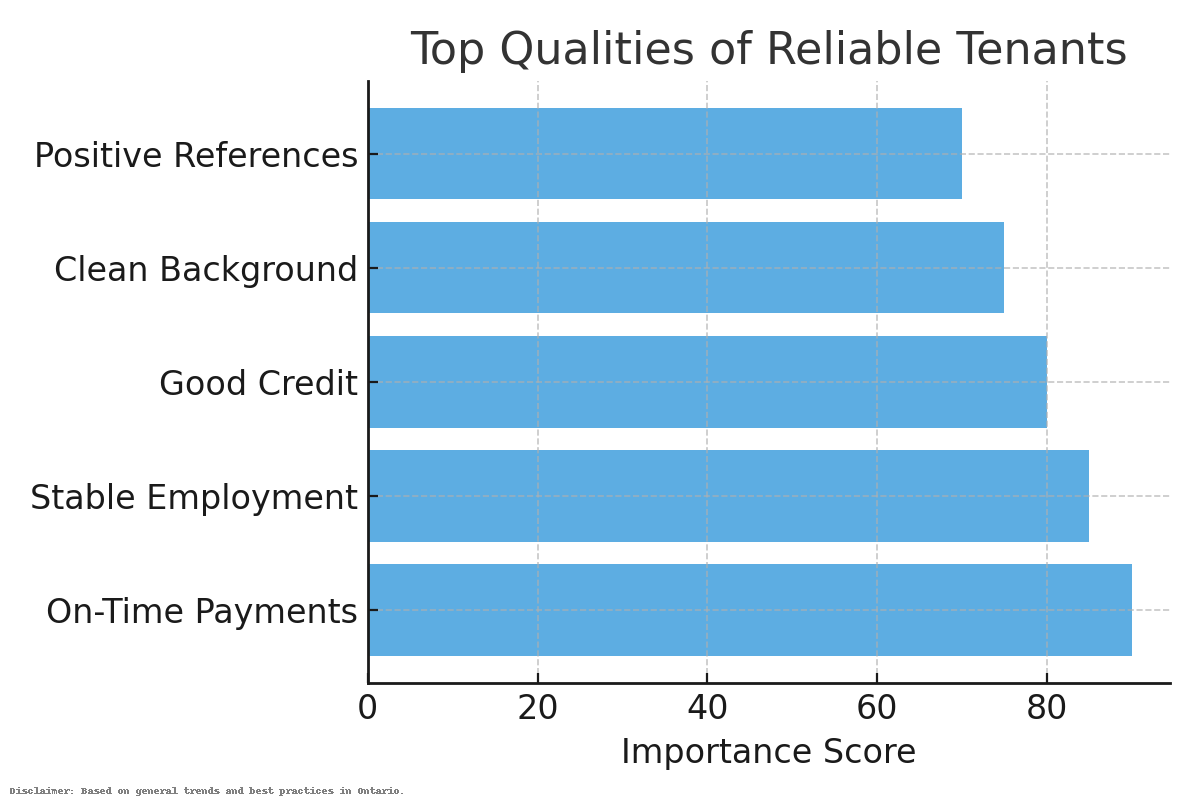
Before you can screen effectively, you need a clear picture of what you are screening for. In our experience managing properties across Belleville and the surrounding region, reliable tenants tend to share a consistent set of characteristics. None of these are guarantees, but they are meaningful signals when taken together.
Stable, verifiable income. The general benchmark is that a tenant's gross monthly income should be at least three times the monthly rent. More important than the ratio, though, is whether the income is verifiable. Employment letters, recent pay stubs, T4s, or Notice of Assessment documents from CRA all work. What does not work is a verbal assurance or a screenshot of a bank balance with no supporting context.
A clean credit history. A credit check tells you how a person has managed financial obligations over time. You are looking for a score in a reasonable range, but more importantly you are looking at the pattern. Collections accounts, repeated late payments, or a history of unpaid utilities are more telling than the score itself. A thin credit file is not automatically disqualifying, especially for younger renters, but it calls for additional verification elsewhere.
Positive rental history. Speaking with a previous landlord, not just a current one, is one of the most underused tools in tenant screening. A current landlord may give a glowing reference simply to move a problem tenant along. A landlord from two tenancies ago has no such incentive. Ask specific questions: Did they pay on time? Did they give proper notice? Would you rent to them again?
Consistency between application and documentation. When a tenant's application, their stated income, their credit report, and their reference all tell the same story, that is a good sign. When they do not align, that is worth exploring before you proceed.
Respectful, organized communication. How a prospective tenant communicates during the showing and application process often reflects how they will communicate as a tenant. Someone who responds promptly, asks reasonable questions, and follows the process you have set out is demonstrating something real about how they operate.
The Screening Process: Step by Step
A good screening process is sequential. Each step builds on the last, and you should not skip ahead based on a good first impression. Here is how we approach it at Blue Anchor.
Step 1: Pre-Qualify Before the Showing
Before you invest time in a showing, ask a few basic questions. What is the applicant's approximate income? How many people will be living in the unit? Do they have pets? When are they looking to move? This is not a formal screening, it is a basic filter to make sure the showing is worth both parties' time. We use our tenant portal to automate much of this intake so that nothing falls through the cracks.
We have also written about why self-showings are a safer approach for landlords, both from a time efficiency standpoint and from a safety perspective. That post goes into the mechanics of how we run showings without requiring a staff member to be present for every unit visit.
Step 2: Collect a Complete Application
Every adult who will be living in the unit should complete a written application. The application should include full legal name, date of birth, current and previous addresses, employment information, income details, references, and written consent to a credit check. Do not accept incomplete applications. An applicant who is unwilling to provide complete information at the application stage is showing you something important.
Step 3: Run a Credit Check
You need written consent from the applicant before pulling a credit report, and you need to comply with Ontario's privacy legislation when handling that data. Several Canadian tenant screening platforms can facilitate this process compliantly. We do not endorse specific brands, but options exist that are built for the Canadian market and pull from Canadian credit bureaus, which matters because US-based platforms often cannot access Canadian credit data accurately.
Step 4: Verify Income Independently
Do not rely on self-reported income. Ask for employment letters on company letterhead, recent pay stubs from the last two to three pay periods, and if the applicant is self-employed, a Notice of Assessment from CRA. For applicants receiving government income support, official documentation from the relevant agency is appropriate. The goal is to confirm that the income is real, current, and sufficient.
Step 5: Contact References Directly
Call the references. Do not accept written references alone. When speaking with a previous landlord, ask open-ended questions rather than yes or no questions. "Can you tell me about their tenancy?" will get you more useful information than "Were they a good tenant?" If a reference number goes to voicemail repeatedly or the person seems reluctant to speak, note that.
Step 6: Make a Decision Based on the Full Picture
Once you have the application, the credit report, the income verification, and the reference calls, you are in a position to make a decision. The decision should be based on the totality of the information, not on any single factor. A strong income with a weak rental history is not automatically a pass. A thin credit file with strong references and solid income documentation may be perfectly acceptable. Use your judgment, but base it on data.
Ontario's Legal Framework for Tenant Screening
Screening in Ontario operates within two overlapping legal frameworks: the Residential Tenancies Act and the Ontario Human Rights Code. Understanding both is not optional.
The Human Rights Code prohibits discrimination in housing on the basis of race, ancestry, place of origin, colour, ethnic origin, citizenship, creed, sex, sexual orientation, gender identity, age, marital status, family status, disability, and receipt of public assistance. That last one is particularly relevant for tenant screening: you cannot refuse an applicant solely because their income comes from ODSP, OW, or another form of public assistance. You can apply income and credit standards, but those standards must be applied consistently to all applicants.
The RTA governs the tenancy itself. Key forms landlords in Ontario need to understand include the N4 (notice to end tenancy for non-payment of rent), the L1 (application to evict a tenant for non-payment), the N12 (notice to end tenancy because the landlord, a purchaser, or a family member requires the unit), and the N13 (notice to end tenancy because of demolition, conversion, or major repairs). Bill 97 (the Helping Homebuyers, Protecting Tenants Act, 2023) introduced changes to the N12 framework, including a 120-day notice path without compensation in certain circumstances. These are forms you hope never to use, but understanding them reinforces why getting the screening right at the start matters so much.
The LTB data we referenced at the top of this article, drawn from the July 2026 Openroom analysis, is publicly available through Ontario's open data catalogue. If you want to understand the scope of what landlords are dealing with at the LTB, our post on Ontario unpaid rent LTB orders breaks down what that data actually shows and what it means for landlords managing properties in this province.
Common Screening Mistakes Ontario Landlords Make
Most screening failures are not the result of bad luck. They are the result of shortcuts taken under pressure. Here are the patterns we see most often.
Rushing because of vacancy anxiety. A vacant unit costs money every day, and that pressure can push landlords to move faster than they should. The math does not support it. A month of vacancy costs you one month of rent. A bad tenant placement can cost you five months of rent plus legal fees plus damage. Slow down.
Accepting a current landlord reference without calling a previous one. As noted above, a current landlord may have every incentive to give a positive reference. Always try to reach at least one previous landlord.
Skipping the credit check because the applicant seems trustworthy. First impressions are not data. A credit check takes minutes and provides information that a conversation cannot. There is no legitimate reason to skip it.
Not verifying income documents. Employment letters can be fabricated. Pay stubs can be altered. If something looks off, call the employer directly using a number you find independently, not one provided by the applicant.
Applying different standards to different applicants. If you require a credit check from one applicant, you must require it from all applicants for that unit. Inconsistent standards create Human Rights Code exposure. Document your process and apply it uniformly.
Ignoring red flags in communication. An applicant who is evasive about their rental history, who pushes back hard on providing documentation, or who tries to rush you through the process is showing you something. Pay attention to it.
Tools and Resources That Help
Good screening does not require expensive software, but it does benefit from a consistent system. Here is what we rely on at Blue Anchor and what self-managing landlords can replicate.
A standardized application form. Using the same form for every applicant ensures you collect consistent information and reduces the risk of inadvertently asking questions that could raise Human Rights Code concerns. Ontario's standard Form 410 is a reasonable starting point, and our post on understanding Form 410 walks through how to use it properly.
Canadian credit reporting access. Several platforms built for the Canadian market allow landlords to request credit reports with tenant consent. Look for one that pulls from a Canadian bureau and handles consent documentation compliantly under PIPEDA.
A tenant portal for document collection. Our property management platform includes a tenant portal that allows applicants to upload income documents, sign consent forms, and complete their application digitally. This reduces back-and-forth, creates a clear paper trail, and speeds up the process without cutting corners.
A renters insurance requirement. We require all tenants in our managed properties to carry renters insurance, and we offer our own renters insurance program that provides $1 million in liability coverage and $100,000 in pet liability coverage for approximately $30 to $42 per month. Beyond protecting the tenant, this requirement filters for tenants who are organized, financially responsible, and willing to follow the terms of their lease. You can read more about why we built this program in our post on why we built our own renters insurance program.
A documented decision record. Keep notes on every application you review, including why you approved or declined each one. If a declined applicant ever files a Human Rights complaint, your documentation is your defense.
Frequently Asked Questions
Can I ask a tenant about their immigration status during screening?
No. Citizenship and place of origin are protected grounds under the Ontario Human Rights Code. You cannot ask about immigration status, and you cannot use it as a factor in your decision. You can verify identity using government-issued ID, but the specific type of ID or the country that issued it cannot be used to screen applicants out.
What happens if I reject a tenant and they file a Human Rights complaint?
The Ontario Human Rights Tribunal has the authority to order remedies including monetary compensation and policy changes. The best protection is a documented, consistent screening process applied equally to all applicants. If you declined an applicant because their credit score was below your stated threshold and you applied that same threshold to every applicant, you are in a defensible position. If you declined based on a gut feeling with no documentation, you are not.
How does the N4 notice period change under Bill 60 affect my screening process?
The shortened N4 notice period, from 14 days to 7 days effective September 21, 2026, means you can initiate the eviction process slightly sooner after a missed payment. But the hearing wait and total case timeline remain largely unchanged. The July 2026 LTB data shows the average non-payment case still reaches $13,544 in unpaid rent by the time of hearing. The N4 change is a marginal improvement, not a structural fix. Your screening process is still the most powerful tool you have.
Is it legal to require a higher income threshold for applicants with pets?
Family status is a protected ground under the Human Rights Code, and some adjudicators have found that applying different financial standards based on pet ownership can intersect with family status in certain circumstances. The safer approach is to apply a consistent income threshold to all applicants and address pets through a separate pet addendum that outlines responsibilities and potential damage liability within the limits permitted by the RTA.
Should I screen differently for shorter-term leases?
In Ontario, all residential tenancies are governed by the RTA regardless of the lease term. A one-year lease becomes a month-to-month tenancy at the end of the fixed term, and the tenant retains all their rights under the RTA. There is no such thing as a short-term residential tenancy that sits outside the RTA framework, at least not in the context of traditional rental housing. Screen every applicant with the same thoroughness regardless of the lease term offered.
Final Thoughts
The July 2026 LTB data is not an abstraction. It represents real landlords in Ontario, many of them in communities like Belleville, Trenton, Cobourg, and Oshawa, who are sitting across a hearing table from a tenant who owes them an average of $13,544 and waiting 52.4 days just to get there. The total exposure across all those cases exceeds $200 million. These are not numbers that come from negligence or bad luck alone. Many of them come from a screening process that moved too fast, trusted too much, or skipped a step that felt inconvenient at the time.
The good news is that tenant screening is entirely within your control. It costs nothing but time to call a previous landlord. It costs very little to run a credit check. It costs nothing to ask for a second pay stub. The process we have outlined in this article is not complicated. It is just consistent, and consistency is what separates landlords who avoid serious problems from those who end up in the LTB data.
At Blue Anchor, we run this process for every property we manage across Central Ontario. If you are self-managing and want to tighten up your approach, start with the steps above. If you are considering working with a property manager, we are happy to talk through what that looks like for your specific situation. You can also explore our service areas directly: Belleville property management, Trenton property management, Cobourg property management, and Oshawa property management.
The front door is where your investment is either protected or put at risk. Treat it accordingly.