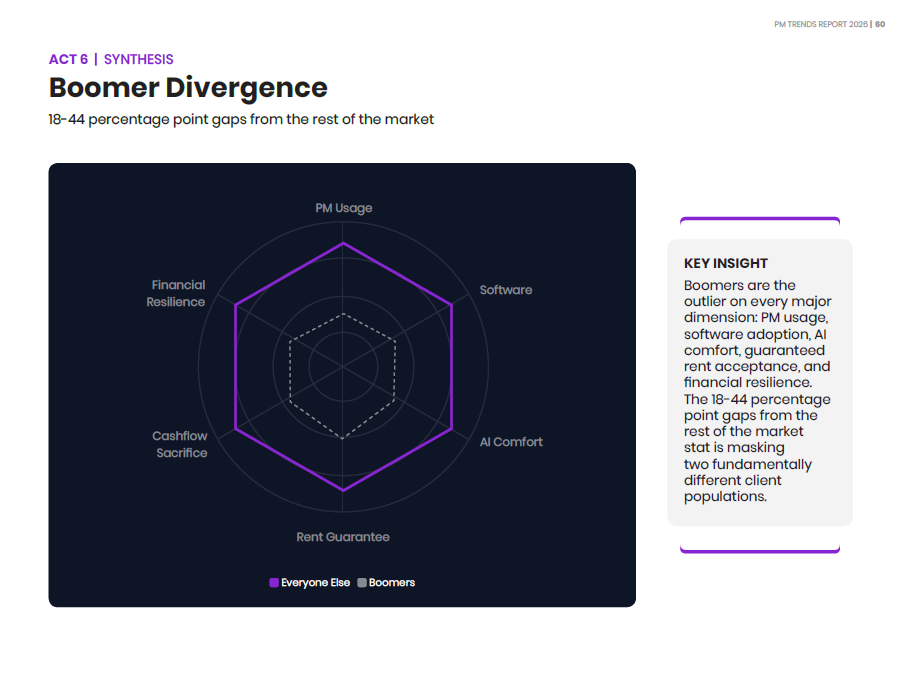
If there is one overarching theme in the 2026 PM Trends Report, it is this: Boomers and everyone else are operating in fundamentally different realities when it comes to rental property — and what they need from a property manager is just as different.
This is not about one generation being right and the other being wrong. It is about recognizing that a 65-year-old who owns a paid-off duplex and a 35-year-old carrying a mortgage on an investment property are in completely different situations. They need different things. And the best property management relationships start with understanding which situation you are in.
The Numbers
The differences between Boomers and the rest of the landlord market run 18 to 44 percentage points across nearly every major dimension measured.
PM adoption: Millennials 73%, Gen X 66%, Gen Z 65%, Boomers 29%. A 44-point gap. And 37% of Boomers say they would never consider hiring a property manager.
Software use: Millennials 81%, Gen X 65%, Gen Z 57%, Boomers 25%. A 56-point gap.
Repair approval threshold: Millennials $500. Boomers $200. That 2.5x difference directly affects how fast repairs get completed — and as we have covered earlier in this series, repairs requiring owner approval take an average of 1.82 extra days.
Rent guarantee acceptance: near-universal among Millennials and Gen X. Boomers at 63%, with roughly a third rejecting the concept entirely.
The researchers describe this as "Boomers versus everyone else" because Gen Z, Millennials, and Gen X all cluster together on most metrics. The divergence is not a gradual generational gradient. It is a cliff between one generation and the other three.
Two Different Relationships with Property Ownership
This is not a technology gap or a generational stereotype. It reflects fundamentally different economic relationships with rental property.
The Boomer owner often bought their rental property decades ago. The mortgage is paid off or nearly so. The rental income is supplemental — welcome, but not essential to their financial stability. Maintenance costs come out of an asset that is already profitable. In that context, a management fee feels like overhead on something that was working fine without it. And a $200 approval threshold makes sense when you have the time to take every call and the mindset that each dollar spent is a dollar off your bottom line.
When Boomers do hire a property manager, the primary driver is overwhelmingly stress relief — at 69%, nearly double the overall average. They are not optimizing their portfolio. They have reached a point where the calls, the maintenance coordination, and the tenant issues have become more than they want to handle. The PM hire is a quality-of-life decision, not a financial optimization.
The Millennial owner is typically in a different position entirely. They bought during the 2019-2022 window, often with a mortgage at rates that require disciplined rent collection and minimal vacancy to maintain positive cashflow. The rental property is a leveraged investment, not a paid-off asset generating bonus income. Every month of vacancy, every expensive repair, and every bad tenant directly threatens the viability of the investment.
In that context, a property manager is not overhead — it is an essential operating expense, like accounting or insurance. Skipping it does not feel like saving money. It feels like taking on operational risk you are not equipped to manage, especially in a regulatory environment as complex as Ontario's.
Millennials split their hiring motivations more evenly: 27% stress relief, 27% cashflow maximization, 19% risk reduction, 15% time savings. They are making a business case with multiple rational inputs, not reaching a breaking point.
What This Means If You Are a Boomer
If you are a Boomer landlord who has been self-managing for years, the data is not telling you that you have been doing it wrong. Your situation — a paid-off property, supplemental income, hands-on involvement — has worked because the economics supported it.
But two things are changing that may affect your calculation.
First, the regulatory environment has evolved significantly. Ontario's Residential Tenancies Act is more complex than it was ten or even five years ago. Standard lease requirements, notice provisions, above-guideline increase applications, and Landlord and Tenant Board processes have all become more demanding. What worked in 2010 does not necessarily work in 2026, and a misstep can be expensive.
Second, the cost environment has shifted. Insurance is up 35% since 2019. Maintenance labour is up 42%. Parts are up 30%. The costs of managing a property — even one that is paid off — are higher than your mental model probably accounts for. As we covered in an earlier post, landlords underestimate these increases by a factor of three.
If self-management still works for you and you enjoy it, that is a valid choice. But if you are finding the regulatory complexity frustrating, the costs surprising, or the tenant communication exhausting, you are not alone — and the 69% of Boomers who hire a PM specifically for stress relief suggest that the breaking point is more common than you might think.
If you do hire a PM, be upfront about what you need. You may want more phone communication and less portal. You may want a lower approval threshold to start, with the option to raise it as trust builds. You may want a simpler service package focused on maintenance and tenant management rather than asset management and financial forecasting. A good PM will calibrate their service to your situation, not force you into a one-size-fits-all model.
What This Means If You Are a Millennial
If you are a Millennial landlord, the data confirms what you probably already sense: professional management is not optional for leveraged rental investments, it is infrastructure.
Your generation is the most likely to use a PM, the most satisfied with PM services, and the most willing to invest in premium offerings that protect your asset. You are also the most likely to have found your PM through AI search or YouTube — which means you probably did your research before you made the call.
The risk for Millennial owners is not under-investing in management. It is choosing the wrong PM. Your expectations are high — and they should be. Look for a PM with a technology stack that gives you real-time visibility into your property's performance. Look for systematic screening processes, not gut-feel tenant selection. Look for proactive communication, not reactive updates when something goes wrong. And look for a PM who treats your property as the leveraged investment it is, not as a side project.
In the Quinte region, we are seeing more Millennial investors every year — buying in Belleville, Trenton, Picton, and across Prince Edward County. They come to us with specific questions about our tech stack, our screening process, our maintenance triage, and our reporting. Those are exactly the right questions.
What This Means If You Are Gen X
Gen X lands in between but closer to the Millennial profile: 66% PM adoption, 65% software use, and hiring motivations that lean toward cashflow maximization (35%) and stress relief (29%). You are the pragmatic middle — experienced enough to know what good management looks like, practical enough to pay for it when the math works.
The Gen X risk is inertia. You may have a PM relationship that is "fine" but not great, and the switching cost feels higher than the benefit. The data suggests it is worth periodically evaluating whether "fine" is actually costing you in deferred maintenance, below-market rents, or tenant quality that you have gotten used to.
The Ontario Dimension
For landlords in the Quinte region and across Ontario, the generational divide has specific local relevance.
The Ontario landlord who says "I have managed my own properties for 30 years and I do not need help" is almost certainly operating with habits and systems calibrated to a regulatory environment that has changed significantly. The RTA has evolved. Standard lease requirements, notice provisions, above-guideline increase processes, and Landlord and Tenant Board procedures are all more complex than they were a decade ago. Self-managing successfully today requires keeping pace with those changes — and many long-time self-managers have not.
The Millennial investor who just bought their first rental in Belleville enters a market where professional management is the expected standard. They are not asking whether to use a PM. They are asking which PM understands their market, their technology expectations, and their investment goals.
The Takeaway
There is no single right way to own rental property. A Boomer with a paid-off duplex and a Millennial with a leveraged fourplex are in genuinely different situations that call for different approaches.
But understanding which situation you are in — and what the data says about how owners in your position get the best results — is worth the reflection. The landlords reporting the highest satisfaction are the ones whose expectations match their PM's capabilities. Whether that means a high-touch, phone-first relationship or a portal-driven, delegation-heavy one, the key is alignment.
At Blue Anchor, we manage properties for owners across every generation and every investment profile. Our systems are built to flex — more communication for owners who want it, more autonomy for owners who trust the process. The common thread is transparency: every owner gets the same reporting quality, the same maintenance standards, and the same commitment to protecting their investment.
Whatever generation you belong to, the question is the same: is your current approach — whether self-management or your current PM — delivering the results your property deserves?
Source: PM Trends Report 2026, Synthesis Section — Boomer Divergence (n=500)