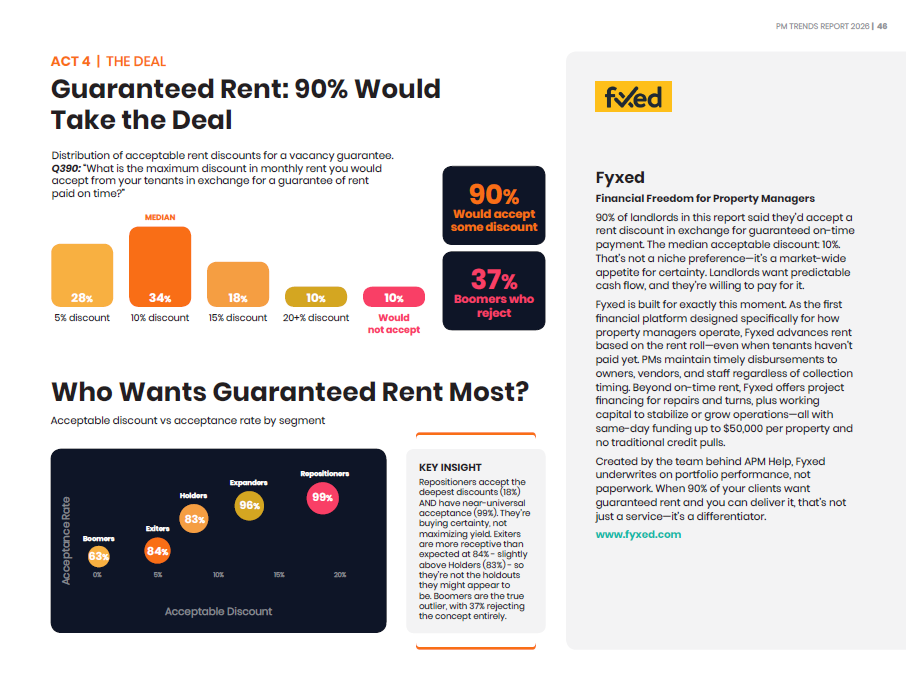
If someone offered you slightly less rent per month but guaranteed it would arrive on time, every month, no matter what — would you take it?
90% of landlords in the PM Trends survey said yes. The median acceptable discount: 10%.
That is not a niche preference held by a nervous minority. That is nine out of ten owners saying they would pay — literally, in the form of reduced rent — for certainty. The emotional and financial weight of "will my tenant pay this month?" is so significant that the overwhelming majority of landlords are willing to price it in.
The Distribution
The breakdown of acceptable discounts reveals how deep this willingness runs. 37% would accept a 5% discount. 28% would accept 10%. 18% would accept 15%. And 10% would accept 20% or more. Only 10% would not accept any discount at all.
The median lands at 10% — meaning most owners would give up roughly one month's rent per year in exchange for guaranteed payment. On a $2,000/month rental, that is $200/month or $2,400/year. They are doing that math and deciding it is worth it.
Who Wants It Most
Repositioners — the most active, most sophisticated investor type — show 99% acceptance and would tolerate up to an 18% discount. They are not buying maximum yield. They are buying certainty so they can focus on portfolio strategy without worrying about individual property cashflow disruptions.
Expanders come in at 96%. Holders at 83%. Even Exiters at 84%. The only significant holdout is Boomers at 63%, with roughly a third rejecting the concept entirely.
What Is Driving This
The default anxiety data provides the context. 48% of Millennials said tenant default is likely. 41% of Gen X agreed. Only 12% of Boomers think default is likely.
Millennials are four times more likely than Boomers to expect default. This is not pessimism — it is a generation that entered the rental market during tighter economic conditions, lived through pandemic-era eviction moratoriums, and has direct experience with the friction that comes when tenants cannot or will not pay.
When you combine that anxiety with near-universal acceptance of rent guarantees, you get a market that is actively searching for someone to solve this problem.
The Ontario Context
Rent guarantee structures in Ontario look different than in the US market, and it is important to be honest about that. We do not have the same insurance product ecosystem. The LTB eviction timeline — which can extend many months — creates a unique risk profile that US products are not designed for. And Ontario's regulatory framework means some guarantee structures that work in American states are not directly applicable here.
But the underlying owner sentiment is identical: certainty is worth paying for.
Several approaches are available. Rigorous screening is the first line of defense. Our screening process is designed to identify tenants with strong payment histories, verified income, and stable employment. The best rent guarantee is a tenant who pays consistently because they were properly vetted.
Reserve fund structures allow property managers to hold a maintenance and vacancy reserve that smooths cashflow disruptions. Rather than a true guarantee, this creates a buffer that handles short-term gaps without disrupting the owner's income.
Rent default insurance, where available, provides a third-party backstop. The Canadian market for this product is evolving, and not all policies are created equal. Coverage terms, exclusions, and claim processes vary significantly.
Proactive communication about late payments, early intervention with tenants who show payment stress, and structured payment plans when appropriate all reduce the likelihood that a late payment becomes a default.
At Blue Anchor, we layer these approaches. Screening prevents most problems. Proactive communication catches the rest early. And our management processes are designed to protect owner cashflow at every stage.
The Bigger Picture
The 90% acceptance rate is not just a product opportunity. It is a window into what landlords are actually feeling. Behind every property investment is a person who worries about whether the income will arrive. That worry does not scale with sophistication — Repositioners worry just as much as Holders, they have just quantified their willingness to pay for relief.
If your property manager has not talked to you about how they handle late payments, default scenarios, and your financial exposure — that is a conversation worth initiating.
Source: PM Trends Report 2026, Q390, Q405 (n=500)