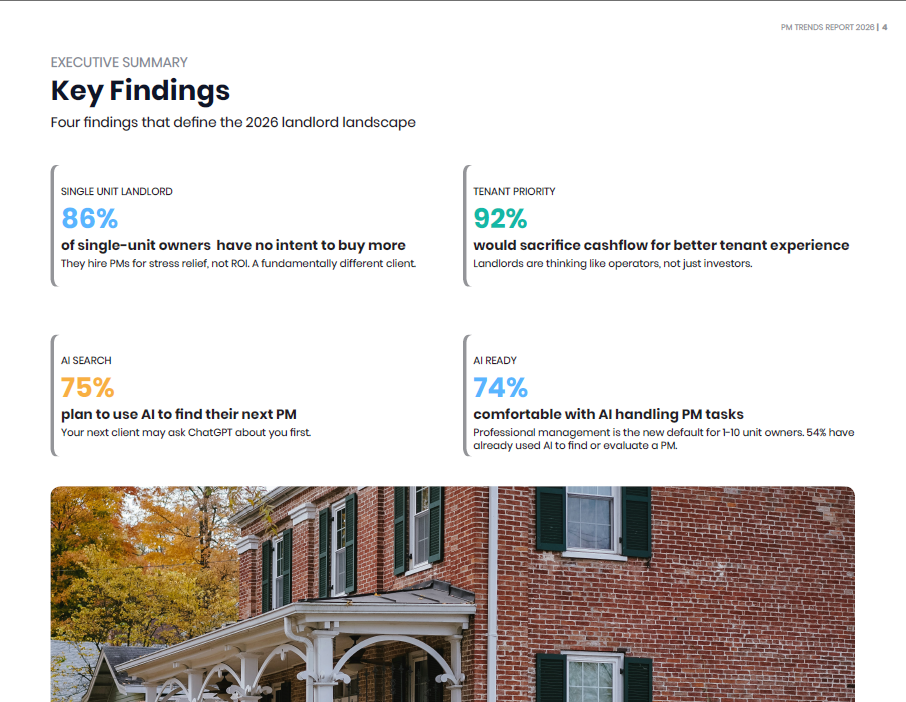
Every year, the LeadSimple team partners with Harris Poll to survey hundreds of small landlords across the United States. The 2026 PM Trends Report just dropped — and whether you own one rental property in Belleville or ten across the Quinte region, the findings are worth your attention.
The study surveyed 500 landlords who own between 1 and 10 residential rental units. That's the demographic we work with every day at Blue Anchor — owners who have real jobs, real families, and real properties that need professional attention. These aren't institutional investors managing thousands of doors through a corporate office. They're people like you.
The researchers narrowed the focus this year to landlords with 10 or fewer units, with 80% of respondents owning between 1 and 5 properties. They also introduced a new segmentation framework — Expanders, Holders, Repositioners, and Exiters — based on buying and selling intent. That framework turned out to reveal insights that raw demographics alone would have hidden.
Four Headline Findings
92% would sacrifice some cashflow for a better tenant experience. This one caught even the researchers off guard. The overwhelming majority of landlords now understand that treating tenants well isn't charity — it's an investment strategy. Good tenants mean fewer turnovers, less damage, more consistent rent, and better long-term property care. Owners are thinking like operators, not just investors. And they want a property manager who shares that mindset.
75% plan to use AI to search for their next property manager. And 54% already have. If your property manager isn't showing up when someone asks ChatGPT or Perplexity about who manages rentals in your area, that's a problem that's only going to get worse. The traditional path — Google search, realtor referral, maybe a Facebook group recommendation — still matters. But the first touchpoint is increasingly an AI conversation, and the property managers who aren't visible in that space are invisible to a growing majority of potential clients.
62% of small landlords now use a property manager. Industry estimates in 2017 placed PM adoption at approximately 30%. In less than a decade, professional management has moved from a minority practice to the majority default. The era of "I'll just handle it myself" is giving way to a broader recognition that managing rental property is a professional skill set, not a side hobby you figure out through trial and error.
86% of single-unit owners have no intent to buy more. They're not scaling. They're not investors in the traditional sense. Most of them hired a property manager for stress relief, not ROI optimization. That fundamentally changes what "good service" looks like for this group. They don't want asset management advice or portfolio growth strategies. They want peace of mind — the knowledge that their property is taken care of, their tenant is happy, and they don't have to think about it.
What the Data Means for Ontario Landlords
The survey is US-based, but the trends translate directly to our market. Ontario's Residential Tenancies Act creates a regulatory environment that's arguably more complex than most American states. Between Landlord and Tenant Board timelines, rent increase guidelines, property standards bylaws, and the evolving above-guideline increase process, the case for professional management in Ontario is at least as strong as it is south of the border.
The demographic shift is global, too. Millennials are now 38% of all landlords in the survey — 1.7 times overrepresented compared to their share of the adult population. In the Quinte region, we're seeing the same pattern: younger investors buying rental properties in Belleville, Trenton, and Prince Edward County, often while working full-time jobs and raising families. They're not interested in midnight maintenance calls or chasing late rent. They want a partner who handles it professionally.
What's Coming Next
Over the next several weeks, I'm going to dig into the data that matters most for rental property owners in our market. Response times and what owners actually expect. Repair approval thresholds and what they reveal about trust. Premium services that half of all landlords would pay extra for. The real numbers on insurance and maintenance costs versus what owners think they are. The generational divide that's reshaping the entire industry.
Every post will be backed by the research, framed for our market, and written for property owners who want to make informed decisions about how their rental is managed.
If you own rental property in the Quinte region — or you're a realtor working with investor clients — this series is for you.
Source: PM Trends Report 2026, LeadSimple and Harris Poll (n=500, fielded December 4-27, 2025). Throughout this series, "landlord" refers to small landlords owning 1-10 rental units unless otherwise noted.