In This Article:
- Why Tenant Screening Matters More Than Ever in Ontario
- What Makes a Reliable Tenant
- The Screening Process: Step by Step
- Ontario's Legal Framework for Tenant Screening
- Common Screening Mistakes Ontario Landlords Make
- Tools and Resources That Help
- Frequently Asked Questions
- Final Thoughts
Finding a good tenant is one of the most important decisions you will make as a landlord in Ontario. Get it right, and you can enjoy years of steady rent, a well-maintained property, and minimal stress. Get it wrong, and you may be looking at months of missed payments, LTB hearings, and costly repairs. The stakes are high, and the process deserves more attention than most landlords give it.
At Blue Anchor, we manage long-term residential rentals across Central Ontario, including Belleville, Trenton, Cobourg, Oshawa, Picton, and Quinte West. Tenant screening is one of the most important services we provide, and over the years we have developed a process that is both thorough and fully compliant with the Residential Tenancies Act. This article shares what we have learned so that landlords, whether self-managing or working with a property manager, can make better decisions at the front door.
If you want to go deeper on how we specifically approach this at Blue Anchor, we have a detailed breakdown in our post on how Blue Anchor screens tenants. But this article gives you the full picture of what good screening looks like in the Ontario context.
Why Tenant Screening Matters More Than Ever in Ontario
Ontario's rental market is unique in Canada. The Residential Tenancies Act (RTA, 2006) provides some of the strongest tenant protections in the country. Once a tenant is in your unit, removing them for non-payment or other issues is a formal legal process that runs through the Landlord and Tenant Board. Even with recent reforms under Bill 60 (the Fighting Delays, Building Faster Act, 2025), which introduced some improvements to LTB timelines, eviction proceedings can still take several months from start to finish.
That reality makes the screening stage your most powerful tool. In our experience managing rentals across Belleville and the surrounding region, the landlords who avoid serious problems almost always have one thing in common: they did not rush the screening process. They asked the right questions, verified the right documents, and trusted the data over a good first impression.
The cost of a bad placement is not just lost rent. It includes LTB filing fees, legal costs, potential property damage, vacancy during the eviction period, and the time you spend managing the situation instead of running your life. A thorough upfront screening process is the most cost-effective investment a landlord can make. You can read more about what that vacancy really costs in our post on the true cost of vacancy.
What Makes a Reliable Tenant
Before you build a screening process, it helps to know what you are actually looking for. Reliable tenants share a few consistent characteristics, and while no checklist guarantees a perfect outcome, these signals are worth paying attention to.
Financial stability is the foundation. A tenant who earns a verifiable income of at least three times the monthly rent has a reasonable buffer to handle unexpected expenses without falling behind. This is not a hard legal rule in Ontario, but it is a widely used benchmark among professional property managers. What matters is that the income is real, consistent, and documentable, whether that comes from employment, self-employment, pension income, or another verifiable source.
Rental history is equally telling. A tenant who has rented before and can provide references from previous landlords gives you a window into how they actually behave as a renter. Did they pay on time? Did they communicate issues promptly? Did they leave the unit in good condition? These questions, asked directly to a previous landlord rather than just accepted on paper, reveal patterns that a credit score alone cannot show.
Communication style matters more than many landlords realize. How a prospective tenant responds to your messages, whether they show up on time, whether they ask thoughtful questions about the lease, these are early signals about how the tenancy will go. At Blue Anchor, we pay close attention to how applicants engage during the showing and application stages. Disorganized, evasive, or pressuring behaviour at the application stage rarely improves once someone is living in your unit.
Other positive indicators include no prior evictions, a clean credit history with no significant collections or judgments, and a stable living situation prior to applying. None of these factors are disqualifying on their own if there is a reasonable explanation, but together they paint a picture of someone who is likely to be a responsible long-term tenant.
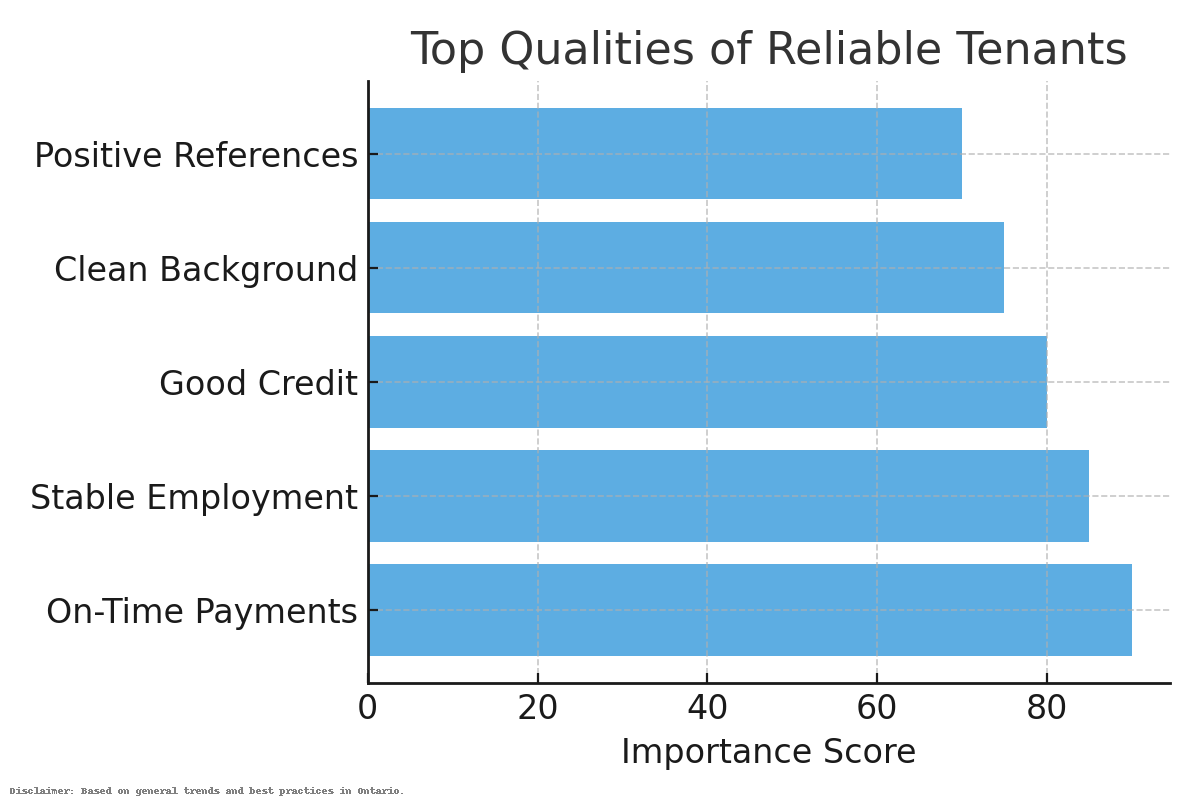 Disclaimer: Based on general trends and best practices in Ontario rental management. For educational purposes only. Not legal advice.
The Screening Process: Step by Step
A well-structured screening process moves in a logical sequence. Skipping steps or doing them out of order is where most landlords run into trouble.
Step 1: Start With a Controlled Showing
The screening process actually begins before the application. How you show the unit matters. At Blue Anchor, we use self-showings for most of our listings, which allows prospective tenants to view the property at their convenience while we capture verified contact information and track who is actually interested. This approach filters out low-intent applicants and gives serious renters a better experience. We wrote about the advantages of this approach in our post on why self-showings are safer.
Step 2: Use a Standardized Rental Application
Every applicant should complete the same written application. This protects you legally and ensures you are comparing apples to apples. A proper Ontario rental application should collect full legal name and government-issued ID, current and previous addresses with landlord contact information, employment details and income documentation, and written consent for a credit and background check. The Ontario Real Estate Association's Form 410 is a commonly used standard, and we have a full breakdown of it in our post on understanding Form 410.
Step 3: Run a Credit Check
With written consent from the applicant, pull a credit report through a Canadian bureau such as Equifax or TransUnion. Look at the overall score, but also look at the details. A score in the mid-600s with one old collection account is very different from a score in the mid-600s with multiple recent missed payments. Patterns of behaviour matter more than the number itself. Services like Certn or Naborly are designed specifically for Canadian tenant screening and can simplify this step.
Step 4: Verify Income
Ask for recent pay stubs, a letter of employment, or Notice of Assessment from the CRA for self-employed applicants. Bank statements can supplement this if the applicant is newer to employment or recently self-employed. The goal is to confirm that the income is real and ongoing, not just claimed on the application form.
Step 5: Call Previous Landlords Directly
This step is skipped far too often. Do not just accept a reference letter. Call the number listed and verify it is actually a landlord, not a friend. Ask specific questions: Did they pay rent on time? Did they give proper notice when leaving? Would you rent to them again? That last question is the most revealing. A hesitant answer or a vague non-answer often tells you everything you need to know.
Step 6: Review Everything Together
No single piece of information should make or break a decision. Look at the full picture. A strong income with a weak rental history is a risk. A modest income with an excellent rental history and solid references may be a better choice. At Blue Anchor, we use a consistent scoring approach so that decisions are based on documented evidence rather than gut feeling, which also protects us from any human rights concerns.
Ontario's Legal Framework for Tenant Screening
Tenant screening in Ontario operates within two overlapping legal frameworks: the Residential Tenancies Act and the Ontario Human Rights Code. Understanding both is not optional. Violations can result in complaints to the Human Rights Tribunal of Ontario and significant financial consequences.
The Ontario Human Rights Code prohibits discrimination in housing based on race, ancestry, place of origin, colour, ethnic origin, citizenship, creed, sex, sexual orientation, gender identity, age, marital status, family status, disability, or the receipt of public assistance. That last point is particularly important. You cannot refuse to rent to someone solely because they receive Ontario Works, ODSP, or another form of social assistance. Income source is a protected ground in Ontario.
What you can do is apply consistent, objective criteria to every applicant. You can assess income level, rental history, creditworthiness, and references. You can decline an applicant because their income does not meet your threshold, as long as you apply that threshold consistently to everyone. What you cannot do is use a protected characteristic as a reason, even informally.
You also cannot require post-dated cheques or mandatory Pre-Authorized Debit (PAD) as a condition of tenancy. Under the RTA, tenants must consent to PAD voluntarily. You can offer it as an option, and many tenants prefer it for convenience, but it cannot be required. For more on how rent collection works within Ontario's legal framework, see our post on rent payment methods for Ontario landlords.
If a tenancy goes wrong despite your best screening efforts, the LTB process begins with serving the appropriate notice. For non-payment of rent, that is an N4 notice. If the tenant does not pay or vacate, you file an L1 application with the LTB. Bill 60, which came into force in 2025, made some improvements to hearing timelines and introduced new tools for landlords dealing with persistent issues, but the process still requires patience and documentation. The better your screening, the less likely you are to ever need it.
Common Screening Mistakes Ontario Landlords Make
In our experience working with landlords across Central Ontario, a few mistakes come up repeatedly. Knowing them in advance can save you a great deal of trouble.
The most common mistake is moving too fast because the unit is vacant. Vacancy has a real cost, and it creates pressure to fill the unit quickly. But placing the wrong tenant costs far more than an extra two or three weeks of vacancy. Rushing the screening process is one of the most expensive shortcuts a landlord can take.
A close second is accepting verbal references without verification. Anyone can claim their previous landlord was happy with them. Calling the reference directly, and confirming they are actually a landlord rather than a friend or family member, is a non-negotiable step.
Another common error is ignoring inconsistencies in the application. If the address history has gaps, if the employment dates do not quite line up, or if the income claimed does not match the documentation provided, these are not minor clerical errors. They are signals worth following up on before you sign a lease.
Finally, many landlords fail to document their decision-making process. If you decline an applicant, keep a record of why, based on objective criteria. This protects you if a human rights complaint is ever filed and demonstrates that your decision was based on legitimate screening factors, not a protected characteristic.
Tools and Resources That Help
Ontario landlords have access to a growing set of tools that make screening more efficient and more defensible. For credit and background checks, Certn and Naborly are both Canadian platforms built specifically for tenant screening. They pull from Canadian credit bureaus, comply with PIPEDA, and generate reports that are easy to read and store.
For property management software, platforms like Rentvine, AppFolio, and Buildium offer application management, document storage, and tenant communication tools. At Blue Anchor, we use Rentvine as our core platform. It handles lease management, maintenance tracking, tenant communication, and accounting in one place. Tenants can view their lease documents, payment history, and submit maintenance requests through the Rentvine portal, while rent itself is collected via Interac e-Transfer or Pre-Authorized Debit.
If you are self-managing and want to protect your investment further, consider our renters insurance program through Walnut Insurance. At Blue Anchor, we offer tenants access to coverage starting at $30 to $42 per month, which includes $1 million in liability coverage and $100,000 in pet liability. This protects both the tenant and the property owner. You can read more about why we built this program in our post on why we built our own renters insurance program.
For landlords who want professional support rather than managing the process themselves, working with a local property management company removes the guesswork. Our teams in Belleville, Trenton, Cobourg, Oshawa, and Picton handle the full screening process on behalf of our clients, using a consistent, documented methodology that holds up to scrutiny.
Frequently Asked Questions
Can I ask a tenant about their income source in Ontario?
You can ask about income level and verify it with documentation. However, you cannot discriminate based on the source of that income. Refusing to rent to someone because they receive social assistance such as Ontario Works or ODSP violates the Ontario Human Rights Code. Apply consistent income thresholds and document your reasoning based on the amount and stability of income, not where it comes from.
Is it legal to run a background check on a tenant in Ontario?
Yes, with written consent from the applicant. You must obtain explicit written permission before running any credit or background check. This is required under Canada's Personal Information Protection and Electronic Documents Act (PIPEDA). Including a consent clause in your rental application form is the standard approach.
What is the income-to-rent ratio I should look for?
Most property managers in Ontario use a benchmark of gross monthly income equal to at least three times the monthly rent. This is not a legal requirement under the RTA, but it is a widely accepted standard that reflects a tenant's ability to pay rent while covering other living expenses. Apply it consistently across all applicants.
Can I reject a tenant because of a previous eviction?
A prior eviction is a legitimate screening factor as long as you apply it consistently and do not use it as a proxy for a protected characteristic. Review the circumstances: an eviction from ten years ago for a situation the applicant can clearly explain is different from a recent eviction for non-payment. Document your reasoning either way.
How long does the LTB process take if a tenant does not pay rent?
Under the current system, after serving an N4 notice and filing an L1 application with the LTB, landlords can typically expect a hearing within several weeks to a few months depending on the region and case complexity. Bill 60 introduced some improvements to timelines in 2025, but the process still requires proper documentation and patience. This is one reason why strong upfront screening is so valuable, it reduces the likelihood of ever reaching this stage.
Final Thoughts
Tenant screening is not about being difficult or suspicious. It is about making a well-informed decision before you enter into a legal relationship that is designed to protect both parties. In Ontario, where the RTA limits your options once a tenancy is in place, the screening stage is genuinely your best opportunity to set your rental up for success.
At Blue Anchor, we treat every application with the same structured process, the same documentation standards, and the same objective criteria. It is one of the reasons our clients experience fewer problem tenancies and more consistent rental income. If you are managing properties in Central Ontario and want to talk about how professional screening fits into a broader management strategy, we would be glad to help. Explore what we do across our service areas or reach out directly to learn more about partnering with us.
Disclaimer: This article is for informational purposes only and does not constitute legal advice. Ontario landlord-tenant law is complex and subject to change. Consult a licensed paralegal or lawyer for advice specific to your situation. For official guidance, visit Tribunals Ontario or Ontario.ca.