Ontario's 2027 Rent Increase Guideline Is 1.9%. Here's the Math Landlords Are Actually Staring At.
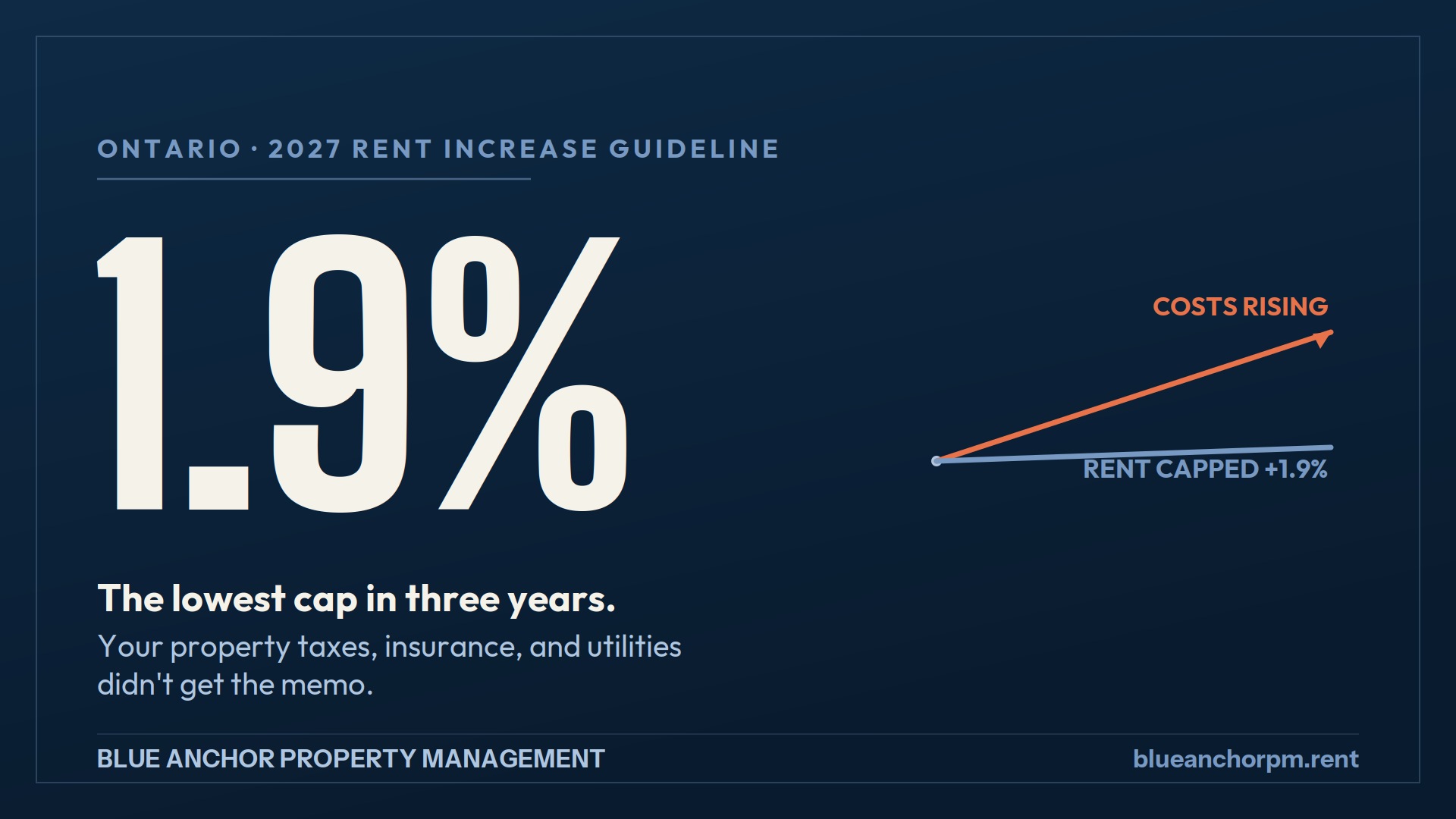
The Province has set the 2027 rent increase guideline at 1.9%. That's the maximum a landlord can raise rent on most sitting tenants next year without going to the Landlord and Tenant Board.
For anyone running the numbers on a rental property in Quinte West, Belleville, Trenton, or Prince Edward County, the reaction is pretty universal: 1.9% doesn't cover what's coming. And you're not wrong. So let's talk about where this number comes from, why it keeps shrinking, and — more importantly — what you can actually do about it.
Where 1.9% comes from
The guideline isn't a number a politician picks out of the air. It's set by formula under section 120 of the Residential Tenancies Act: the average of Ontario's monthly Consumer Price Index over the 12-month window ending in May of the previous year. For the 2027 guideline, that's roughly June 2025 through May 2026.
In other words, the guideline is a rear-view mirror. It reflects last year's headline inflation — and it's legally capped at 2.5% no matter how high inflation actually runs. So when general CPI cools, the guideline drops:
- 2025: 2.5%
- 2026: 2.1%
- 2027: 1.9%
Three years of decline — we broke down last year's 2.1% guideline in detail here. Meanwhile, almost nobody who owns property would tell you their operating costs have cooled.
One thing that hasn't changed is the mechanics. To apply even the 1.9%, you still have to serve your tenant an N1 — Notice of Rent Increase, give at least 90 days' written notice using the official LTB form, and respect the once-every-12-months rule. Get the notice wrong and you don't just delay the increase — you can invalidate it entirely and have to start over.
The problem: your costs don't follow CPI
Here's the disconnect that makes 1.9% feel insulting. The guideline tracks a basket of consumer goods — groceries, gas, clothing, the stuff that gets averaged into headline inflation. It does not track the cost of owning and operating a rental property, and those two things have come unglued.
The line items that actually move a landlord's bottom line are running well ahead of 1.9%:
- Property taxes. Municipal budgets across the Quinte region have leaned on residential property tax increases to close funding gaps. A reassessment or a multi-point municipal levy increase can blow past the guideline on its own — and that's before you've touched a single repair.
- Insurance. Premiums on rental dwellings have climbed hard, driven by claims costs, replacement-value inflation, and insurers tightening their appetite for tenant-occupied properties.
- Utilities. Where the owner carries heat, water, or hydro, those costs have moved faster than the rent you're allowed to charge to offset them.
- Maintenance and trades. Labour and materials don't price themselves to a CPI average. A roof, a furnace, a turnover make-ready — none of it got 1.9% cheaper.
When your revenue ceiling is pinned to a shrinking, backward-looking number and your largest expenses are compounding faster, margin gets squeezed from both ends. That's the real story behind the headline.
What you can actually do about it
Frustration is fair. But there are real levers here, and most landlords leave money on the table simply because they don't use them. This is the part worth reading twice.
1. Above-Guideline Increases (AGIs) exist for exactly this reason
The guideline is the default ceiling — not an absolute one. If you've been hit with an extraordinary increase in property taxes, or you've completed eligible capital work (think a roof, major building systems, balconies, energy or security upgrades), you can apply to the LTB for an Above-Guideline Increase.
An AGI can be worth up to 9% in a single application, which the Board spreads over up to three years (capped at 3% above guideline in any one year). It's a paperwork-and-evidence process, not a rubber stamp — you have to prove the cost and that it qualifies — but for owners eating a tax spike or a big capital outlay, it's the legitimate mechanism the legislation provides. Most owners never file one. They should at least know it's there.
2. The guideline doesn't apply to every unit
Units first occupied for residential purposes after November 15, 2018 are exempt from the guideline. If you own a newer build, a recently created legal basement suite, or an addition that meets the test, you are not bound to 1.9% — you can set increases at market. Knowing which of your units are exempt (and being able to prove it if challenged) is one of the most overlooked pieces of a portfolio's economics.
3. Turnover is where rent resets to reality
Ontario's guideline controls rent for the sitting tenant. When a unit turns over, you and the new tenant agree on the rent from scratch. That means every vacancy is the one moment your rent can catch up to the market — and it makes two things financially critical: pricing the unit correctly on re-rent, and not turning units unnecessarily through avoidable tenant churn. A unit you keep below market for years because you never reset it on turnover quietly costs you more than any single guideline year ever will.
4. Defend the margin on the cost side
If revenue is capped, the other half of the equation is the only place left to fight. That's not a slogan — it's where disciplined operators separate from the pack:
- Getting maintenance triaged and dispatched fast, before a small issue becomes an emergency callout
- Buying repairs through real vendor relationships instead of one-off retail pricing
- Catching tax reassessments and appealing the ones that are wrong
- Reviewing insurance coverage annually instead of auto-renewing into premium creep
- Keeping units occupied with qualified, screened tenants so you're not absorbing vacancy and turnover costs in the same year
None of that shows up in the rent increase headline. All of it shows up in your year-end statement.
The bottom line
1.9% is a low number, and it lands at a time when the costs of actually owning a rental are anything but low. That tension is real, and pretending otherwise doesn't help anyone. But the landlords who come out of 2027 in good shape won't be the ones who spent the year angry at the guideline — they'll be the ones who used the AGI process where it applied, priced their turnovers properly, knew exactly which units were exempt, and ran a tight enough operation that the cost side didn't eat them alive.
That's precisely the work we do for owners every day. If your property is getting squeezed between a capped guideline and rising costs and you want a team that actually knows where the levers are, let's talk: blueanchorpm.rent.
This article is general information for Ontario rental property owners and isn't legal advice. Rent increase rules, exemptions, and AGI eligibility depend on your specific unit and circumstances — confirm the details for your property before acting.