There is a growing cohort of rental property owners who never planned to be landlords at all. They listed their home for sale. The market did not cooperate. And now they are renting out a property they intended to leave behind.
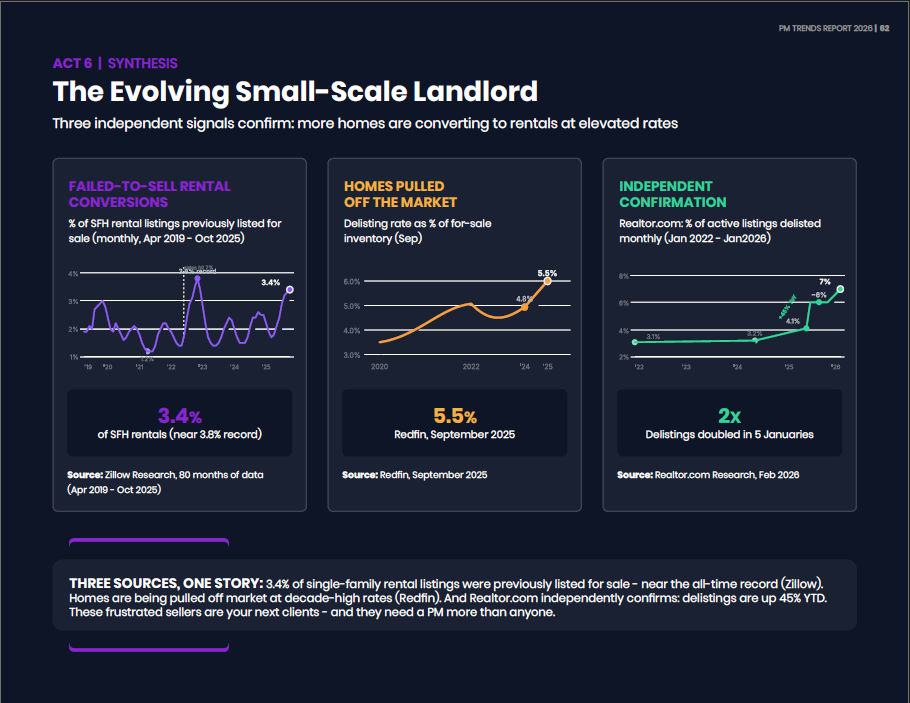
The PM Trends Report flagged a trend that three independent data sources all confirm: failed-to-sell rental conversions are near all-time highs.
The Data From Three Directions
Zillow's research tracking 80 months of data shows that 3.4% of single-family rental listings were previously listed for sale — just below the all-time record of 3.8%. That may sound like a small percentage, but applied across millions of rental listings nationally, it represents a substantial and growing pipeline of accidental landlords.
Redfin confirms from a different angle: homes are being pulled off the market at decade-high rates. Owners who expected to sell are deciding — or being forced — to hold. And Realtor.com data independently shows delistings up significantly year-over-year, with the trend accelerating.
Three sources. Three different methodologies. One consistent story: more homeowners are failing to sell and converting to rental.
Who These Owners Are
Only 5% of landlords in the PM Trends survey self-identified as accidental. But that self-reported number almost certainly understates the reality, because many owners who started by accident have since rationalized the decision. They will tell you they are building equity or waiting for the market to recover, but the origin story is the same: they could not sell.
These owners are fundamentally different from intentional investors. They did not research cap rates, run pro forma analyses, or deliberately choose to own rental property. They stumbled into it through circumstance — inheritance, relocation, divorce, market timing. And they are navigating a regulatory and operational landscape they never planned to learn.
In Ontario, the complexity multiplies. The Residential Tenancies Act governs virtually every aspect of the landlord-tenant relationship. Standard lease forms are mandatory. Rent increase guidelines are set annually by the province. Eviction requires Landlord and Tenant Board adjudication with timelines that can stretch months. An accidental landlord who tries to manage this independently is operating in a regulatory environment they likely do not understand — and the consequences of getting it wrong can be severe.
Why They Need Professional Management Most
The PM Trends Report found that stress relief is one of the two primary reasons landlords hire a property manager, tied with cashflow optimization at 32% each. For accidental landlords, stress relief is almost certainly the dominant driver — and it might be the only one that matters.
These owners are not comparing PM fees against their ROI spreadsheet. They are comparing the stress of dealing with tenants, maintenance, legal compliance, and midnight phone calls against the cost of paying someone to handle it. For most, the math is simple: any management fee that returns their peace of mind is money well spent.
The after-hours data reinforces this. 98% of landlords expect some level of after-hours access to their property manager. For an accidental landlord who is already stressed about a rental they did not want, getting a tenant call about a furnace failure at 11pm on a January night in Belleville is the exact scenario that makes them want to sell at any price. A property manager absorbs that stress. The owner sleeps through the night.
The Referral Pathway for Realtors
If you are a realtor in the Quinte region, this data describes a scenario you have almost certainly encountered: a listing that sat for 60, 90, 120 days without acceptable offers. The conversation with your client shifts from "let us wait for a better offer" to "have you considered renting it while the market adjusts?"
That next sentence — the one where you recommend a specific property manager who can handle the transition professionally — is one of the most valuable referrals in the entire real estate ecosystem. The owner gets professional management. The PM gets a new client. And you have provided genuine value to a client who was stuck, which strengthens your relationship for the eventual sale.
At Blue Anchor, we have onboarded multiple owners in exactly this situation. The playbook is straightforward and designed to minimize stress for someone who is already overwhelmed: realistic rental valuation based on current market data, professional listing preparation with quality photos, rigorous tenant screening through our Front Lobby and Verifast process, a fully compliant Ontario standard lease, and a management structure that lets the owner step away completely from day one.
Many of these owners planned to rent for a year while the sale market recovered. Most are still with us years later — because the property performs well, the tenant is good, and the hassle factor dropped to zero.
The Opportunity
The PM Trends Report calls frustrated sellers "your next clients" and the data supports it. They need professional management more than almost any other segment. They are highly motivated to delegate. And they tend to stay long-term once the initial panic subsides and the rental starts performing.
If you know someone whose listing did not sell — or if you are sitting on a property you cannot move — this is the conversation worth having. The transition from frustrated seller to confident landlord is shorter than most people expect, with the right support.
Source: PM Trends Report 2026; Zillow Research (Apr 2019 - Oct 2025); Redfin Sep 2025; Realtor.com Research Feb 2026