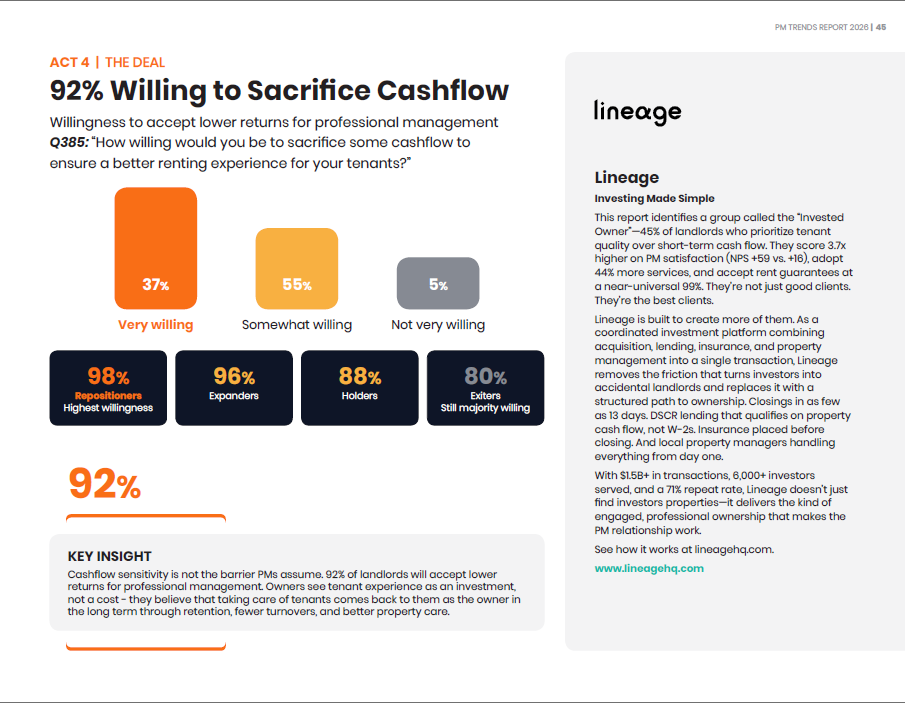
This might be the most counterintuitive finding in the entire PM Trends Report: 92% of small landlords said they'd be willing to sacrifice some cashflow to ensure a better renting experience for their tenants.
Read that again. Nine out of ten owners are telling researchers that maximizing every dollar of rent isn't the goal — quality of tenancy is.
The breakdown by investor type makes this even more compelling. 98% of Repositioners — landlords actively buying and selling properties — said they'd accept lower returns for better tenant experience. 96% of Expanders — those actively growing their portfolios — agreed. Even among Exiters, the group planning to sell and leave the market entirely, 80% still said yes.
What's Actually Driving This
Landlords have figured out what experienced property managers have known for years: good tenants are cheaper than bad ones. A tenant who stays three years, takes care of the property, pays on time, and communicates respectfully is worth far more than extracting an extra $50 per month from someone who trashes the unit, ghosts on rent, and forces you into an expensive turnover cycle.
The math isn't complicated. A turnover in Ontario can easily cost $3,000-5,000 or more when you factor in vacancy time, cleaning, minor repairs, listing costs, and the time invested in showing the unit and screening applicants. That's before any damage beyond normal wear. If raising rent by $50/month causes a good tenant to leave, you've spent a year's worth of that increase — and then some — just getting back to where you started.
Owners are increasingly viewing tenant quality as an asset class decision, not a transactional one. They're not asking "how much can I charge?" They're asking "how do I attract and keep the kind of tenant who protects my investment over time?"
The Premium Services Connection
The same study reinforces this shift through the premium services data. When asked which services they'd be willing to pay extra for, 50% said tenant damage protection, 50% said quarterly property inspections, 51% said asset management and financial forecasting, and 50% said all-in-one financial services.
These aren't luxury add-ons anymore. They're what half the market now expects from a professional property manager. And the willingness to pay for them tracks directly with the cashflow sacrifice finding — owners who view tenant experience as an investment are the same owners who want proactive protection and oversight, not just reactive maintenance dispatch.
The parenting angle is worth noting, too. The report found that parents are significantly more interested in premium services across every single category. Time scarcity matters. When you're raising kids and working full-time, the bandwidth for reviewing inspection reports, chasing insurance quotes, and coordinating repair approvals shrinks fast. These owners don't want to be less involved in their investment — they want a manager who handles the execution so they can stay involved at the strategic level.
What This Means for How We Screen Tenants
At Blue Anchor, this finding validates the approach we've built our entire operation around. Our tenant screening process isn't designed to find someone who can technically afford the rent. It's designed to find someone who will take care of your property like they own it.
That means a layered approach: Front Lobby credit and background screening, Verifast income verification, personal reference checks, rental history verification, and a structured interview process. Every step exists because the data confirms what we see every day — the quality of your tenant is the single largest variable in your property's long-term performance.
We've turned down applicants who could pay the rent but showed patterns that predict problems. We've recommended tenants whose income was modest but whose references, rental history, and interview responses signaled long-term reliability. The 92% number in this survey tells us that owners understand this trade-off intuitively, even if they haven't always had a property manager willing to execute on it.
The Takeaway for Owners
If you're still evaluating your property manager purely on management fee percentage, you're optimizing for the wrong number. The real question isn't "what does my PM cost?" It's "how much is my PM saving me on turnover, vacancy, and damage over a three to five year window?"
That's a completely different conversation. And it's the one that 92% of landlords are now ready to have.
Source: PM Trends Report 2026, Q385 (n=500)