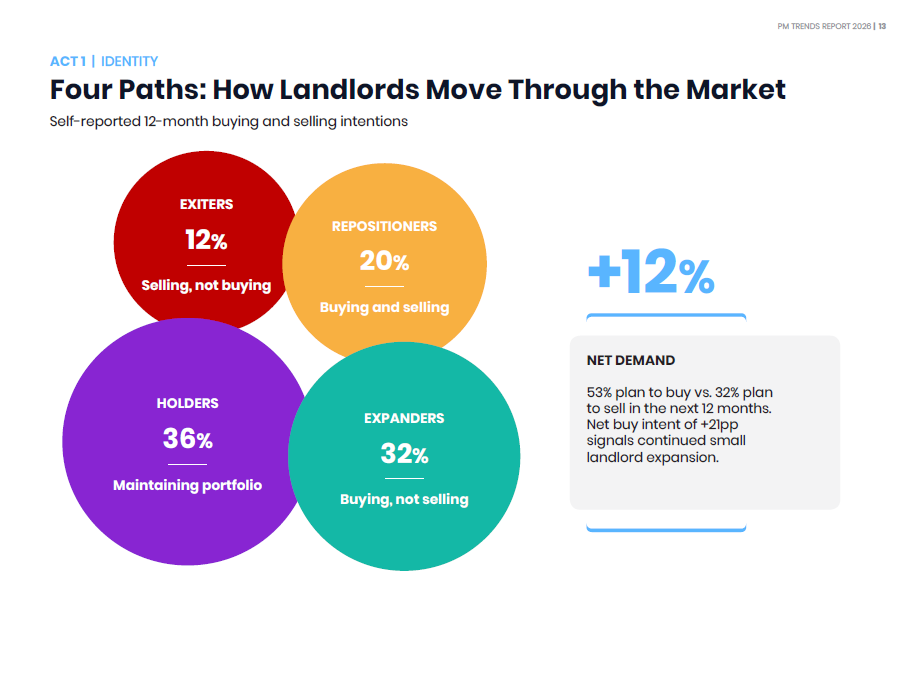
One of the most useful frameworks in the 2026 PM Trends Report is the segmentation of landlords into four behavioural types based on their buying and selling intentions over the next 12 months. Once you see where you fit, a lot of your decisions — and frustrations — start to make more sense.
The Four Archetypes
Expanders (32%) are buying more units and not planning to sell. These are growth-oriented investors building their portfolios actively. 60% currently use a property manager. They tend to be hands-on and research-driven, but increasingly delegation-ready as they add doors. Their median repair approval threshold is $560 — the highest of any group — which signals confidence in both their PM and their own financial position.
Holders (36%) are the largest group. Not buying, not selling, just maintaining what they have. They're steady-state owners who want reliability and consistency. Lower tech adoption, lower AI comfort, lower willingness to pay for premium services. They're not disengaged — they're stable. Their primary need from a PM is predictability: consistent communication, no surprises, competent maintenance handling.
Repositioners (20%) are the power users of the entire dataset. They're simultaneously buying and selling — actively rotating their portfolio to optimize returns. A staggering 93% use a property manager. They have the highest software adoption, highest AI comfort, highest willingness to pay for premium services, and the strongest preference for every value-added offering measured. They are the most demanding clients in the survey — and as we'll see in a later post, the most satisfied.
Exiters (12%) are planning to sell and not buying. They're winding down their rental portfolio. Lowest PM adoption at 39%, lowest tolerance for unexpected costs, and lowest engagement across virtually every metric. Property management is a cost centre they're looking to reduce. They keep the tightest financial leash, with the lowest approval thresholds and the least interest in premium services.
Why Trajectory Matters More Than Portfolio Size
Here's what makes this framework so revealing: these four segments predict behaviour far more accurately than portfolio size, income level, or even generation.
Repositioners will tolerate 3.5 times more unexpected repair cost than Exiters. The gap between an Expander's $560 approval threshold and a Boomer Exiter's $200 threshold isn't about how many properties they own — it's about their relationship with the investment.
Financial resilience follows the same pattern. 73% of Repositioners can absorb $15,000 or more in unexpected costs. Only 21% of Exiters can say the same. When a major HVAC system fails or a roof needs emergency repair, the Repositioner approves the work and moves on. The Exiter considers selling.
PM adoption mirrors trajectory almost perfectly. Repositioners at 93%, Expanders at 60%, Holders at 54%, Exiters at 39%. The more active an owner's investment strategy, the more likely they are to delegate management professionally.
What This Means for You
If you're an Expander, your primary challenge is that self-management works fine at two or three doors — but it becomes the bottleneck that prevents you from acquiring more. The time you spend managing existing properties is time you're not spending on finding, evaluating, and closing your next deal. That's usually the inflection point where a PM pays for itself through opportunity cost alone. In the Quinte region, we're seeing Expanders increasingly come to us after their third or fourth property, when the management overhead starts competing with their acquisition timeline.
If you're a Holder, you're looking for a PM who doesn't try to sell you on things you don't need. You want competent maintenance, consistent communication, and clean books. The risk for Holders is complacency — staying with an underperforming PM or self-managing poorly because the property is "fine" and change feels unnecessary. The data shows Holders have the lowest NPS spread, meaning they're neither thrilled nor angry. They're just there. If that sounds like you, it's worth asking whether "fine" is actually costing you more than you realize in deferred maintenance, below-market rents, or tenant quality.
If you're a Repositioner, you already know what you need — speed, data, premium services, and a PM who can keep pace with your activity level. You're the highest-value client in the market. The question isn't whether to use a PM. It's whether your PM can operate at the level your strategy demands.
If you're an Exiter, the temptation is to cut costs and coast to the sale. But the data suggests a different approach: the PMs who serve Exiters well earn referrals that outlast the client relationship. Your property still needs to be maintained to protect its sale value. Your tenant still deserves professional management. And the realtor or investor you refer to your PM after you sell could be a client relationship worth more than yours.
Net Market Demand
One more data point worth noting: 53% of landlords plan to buy more property in the next 12 months, versus 32% who plan to sell. That's a net buy intent of +21 percentage points, signaling continued expansion of the small landlord market.
Source: PM Trends Report 2026, Reference Section — Trajectory Segments (n=500)