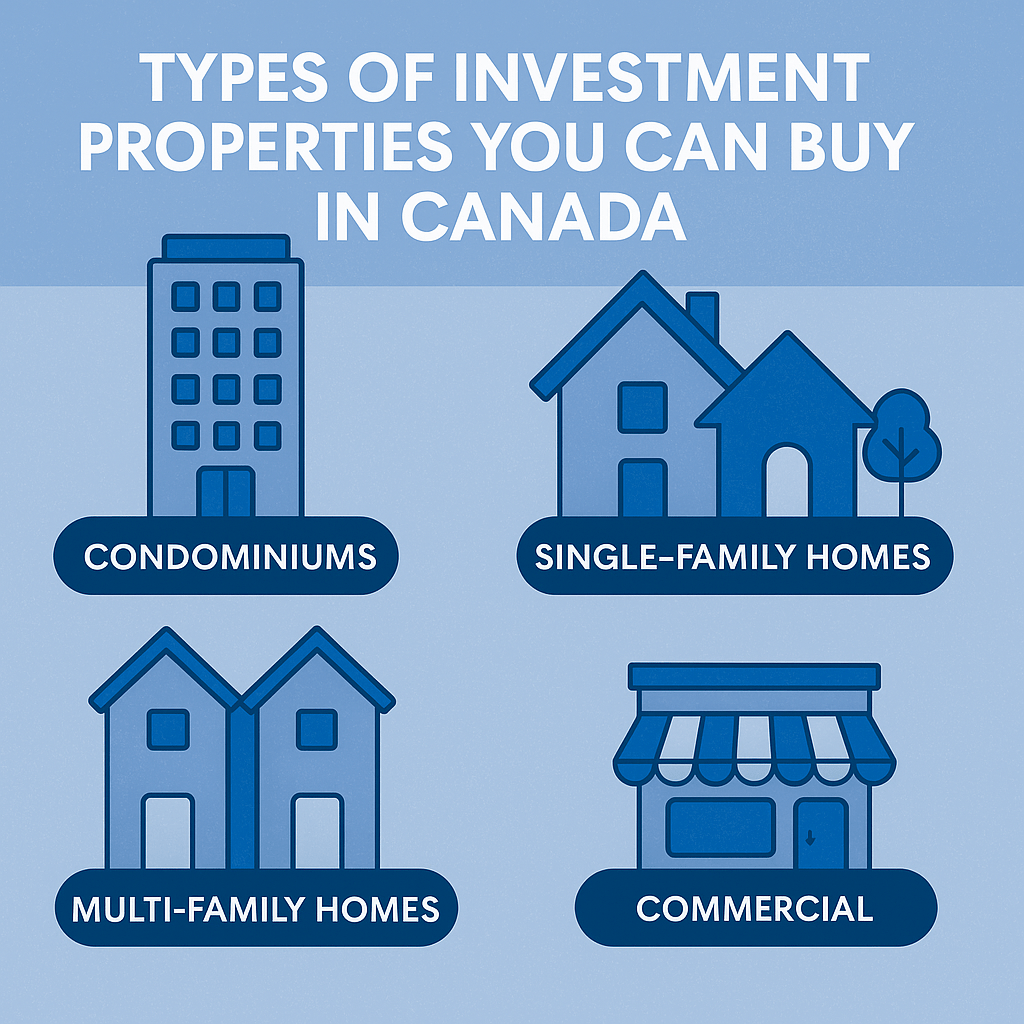
If you are thinking about putting money into Canadian real estate, the first question you will face is not where to buy or how much to spend. It is what type of property to buy. The answer shapes everything that follows: your financing options, your tenant pool, your legal obligations, your tax position, and how much time the investment will demand from you.
This article is about discovery, not deep comparison. Think of it as a first orientation to the property classes available to Canadian investors, with a particular focus on what those classes look like in Ontario. Once you know which category interests you, you can dig into the specifics. We have a companion article that goes further into the practical side of the types of investment properties you can buy in Canada, including acquisition considerations and financing structures worth knowing before you commit.
At Blue Anchor, we manage long-term residential rental properties across Central Ontario, including Belleville, Trenton, Cobourg, Oshawa, Picton, and Quinte West. We work with investors at every stage, from first-time landlords buying a single-family home to portfolio holders managing multiple units across several municipalities. What we see consistently is that investors who understand the property categories before they buy make far fewer expensive mistakes after they close.
Single-Family Homes: The Entry Point Most Investors Know
A detached house rented to one household is the most familiar investment property type in Canada, and for good reason. It is the easiest to finance, the easiest to insure, and the easiest to understand. You buy a house, you find a tenant, you collect rent. The mechanics are straightforward.
In Ontario, single-family rentals are governed by the Residential Tenancies Act (RTA, 2006), which means your tenant has strong protections and you have defined obligations around maintenance, entry, and rent increases. The 2026 rent increase guideline sits at 2.1%, so if you have a long-term tenant in place, your ability to grow rent is limited unless you qualify for an above-guideline increase.
What single-family homes offer that other property types do not is simplicity of management. One tenant relationship, one set of utility accounts, one maintenance history. For investors who are just getting started or who want a relatively passive investment, this is often the right place to begin. In markets like Belleville and Cobourg, detached homes in the $400,000 to $600,000 range can generate gross rents that produce reasonable cap rates, particularly when purchased with a longer hold horizon in mind.
The limitation is scale. A single-family home gives you one income stream. If the tenant leaves, your vacancy rate is 100%. That concentration of risk is something every investor should think about honestly before buying.
Condominiums: Urban Access at a Lower Entry Price
Condominiums are the dominant investment vehicle in major Canadian urban centres, particularly Toronto, Ottawa, and Hamilton. They allow investors to enter high-demand rental markets at a lower absolute price point than a detached home in the same area, and they typically attract tenants who want low-maintenance urban living.
What makes condos distinct as an investment type is the layered governance structure. You own your unit, but the building is managed by a condo corporation. That corporation sets rules, collects common element fees, and can impose special assessments for major repairs. As an investor, you are subject to those rules even when they conflict with what you want to do with your unit. Some condo corporations restrict rentals outright or limit the number of units that can be rented at any given time, which is a detail buyers sometimes discover too late.
Condo fees also compress your net operating income in ways that are easy to underestimate at the purchase stage. A unit with strong gross rent can produce disappointing cash flow once you account for monthly fees, property tax, and mortgage carrying costs. In our experience working with investors who have transitioned from condo ownership to single-family or multi-unit properties, the cash flow picture often improves significantly once the condo fee is removed from the equation.
That said, condos remain a legitimate investment category, particularly for investors who want exposure to urban rental demand without the maintenance responsibilities that come with owning a full building.
Multi-Family Properties: Where Cash Flow Becomes Real
A duplex, triplex, or small apartment building changes the investment equation in a meaningful way. Instead of one income stream, you have two, three, or more. Vacancy in one unit does not stop cash flow entirely. And in many cases, the per-door acquisition cost is lower than buying the equivalent number of single-family homes separately.
In Ontario, multi-family residential properties with fewer than seven units are still governed by the RTA, which means the same tenant protections apply. Buildings with more than six units may fall under different financing and regulatory frameworks, and that threshold matters when you are planning a portfolio strategy.
At Blue Anchor, we manage a number of multi-unit residential properties across Central Ontario, and we consistently find that the operational complexity scales more slowly than the income does. Managing a triplex is not three times harder than managing a single-family home. It requires good systems, clear communication, and reliable maintenance coordination, but those are solvable problems. The tenant screening process we use applies equally whether we are placing one tenant or filling three units in the same building.
For investors in markets like Oshawa or Quinte West, where purpose-built rental supply has not kept pace with demand, well-maintained multi-family properties attract strong tenant interest and tend to hold their value through market cycles.
Commercial Real Estate: A Different Asset Class Entirely
Commercial real estate includes retail storefronts, office space, industrial units, and mixed-use buildings. It operates under an entirely different legal and financial framework than residential property. Leases are negotiated rather than standardized, tenants are businesses rather than individuals, and the RTA does not apply. Commercial landlords and tenants settle disputes through the courts, not the Landlord and Tenant Board.
The upside of commercial investment is the potential for longer lease terms, triple-net structures where tenants cover operating costs, and higher yields in some asset classes. The downside is higher vacancy risk, more complex financing, and the reality that commercial markets in smaller Ontario cities can be thin. A vacant retail unit in a secondary market can sit empty for a long time.
It is worth being direct here: Blue Anchor does not manage commercial properties. Our expertise is in long-term residential rentals, and that is where we focus. If you are exploring commercial investment, you will need a property manager with commercial experience and a different set of legal advisors. We mention commercial real estate here because it is part of the full picture of Canadian investment property types, not because it is something we can help you operate.
Short-Term and Vacation Rentals: High Profile, High Risk
Platforms like Airbnb and VRBO have made short-term rental income visible to a generation of investors who might not have considered real estate otherwise. The income per night can look impressive compared to monthly residential rent, and the flexibility of owner use appeals to some buyers.
What the income figures often obscure is the operational intensity. Short-term rentals require near-constant turnover management, cleaning coordination, dynamic pricing, guest communication, and compliance with municipal licensing requirements that vary significantly across Ontario. Many municipalities, including several in the Quinte region, have introduced or are actively developing short-term rental bylaws that restrict where and how these properties can operate.
Blue Anchor does not manage short-term rentals. We focus exclusively on long-term residential tenancies, and we think that is the right model for most investors who want a property that builds wealth without consuming their time. If you are drawn to short-term rental income, understand that you are entering a hospitality business, not a passive investment, and plan accordingly.
What This Looks Like in Central Ontario Specifically
National conversations about investment property types can feel abstract when you are looking at a specific market. In Central Ontario, the practical reality is that single-family homes and small multi-unit properties dominate the investor landscape. The condo market is present in larger centres like Oshawa but is less developed in Belleville, Trenton, or Picton. Commercial investment exists but requires specialist knowledge that most residential investors do not have.
The May 2026 Ontario rental market report gives a current picture of where demand is concentrated and what vacancy rates look like across the region. That kind of market-level data is worth reviewing before you decide which property type to target in which community.
At Blue Anchor, we work with investors who own properties in Belleville, Trenton, Cobourg, Oshawa, and Picton. Each of those markets has its own character, its own tenant demographics, and its own supply dynamics. The property type that performs well in one community does not automatically perform the same way in another.
In our experience, investors who take the time to understand both the property category and the specific local market before they buy are the ones who call us two years later with a well-tenanted property that is performing as expected. The ones who skip that step are the ones who call us with problems.
Frequently Asked Questions
What is the most common type of investment property for first-time investors in Ontario?
Single-family detached homes are the most common entry point for first-time investors in Ontario. They are straightforward to finance, insure, and manage, and they are governed by the familiar framework of the Residential Tenancies Act. Many investors in Central Ontario start with a single-family rental in a community like Belleville or Cobourg before expanding to multi-unit properties.
Do all residential investment properties in Ontario fall under the Residential Tenancies Act?
Most do, but there are exceptions. Some exempt categories include properties where the owner and tenant share a kitchen or bathroom, certain co-operative housing arrangements, and some care homes. For standard residential rentals, including single-family homes, duplexes, triplexes, and apartment buildings, the RTA applies. You can find the full list of exemptions on the Ontario.ca RTA legislation page.
Can I convert a single-family home into a duplex to increase rental income?
Yes, in many Ontario municipalities this is possible, but it requires a building permit, compliance with local zoning bylaws, and potentially a separate entrance. The rules vary significantly by municipality. Some communities in Central Ontario have been actively encouraging secondary suites as a way to increase rental supply. Always confirm local zoning requirements before purchasing a property with conversion in mind.
What is the 2026 rent increase guideline for Ontario?
The Ontario rent increase guideline for 2026 is 2.1%. This applies to most residential rental units that were first occupied before November 15, 2018. Units first occupied after that date are exempt from rent control under current legislation. Landlords must provide proper written notice using the correct form before any rent increase takes effect.
Does Blue Anchor manage all types of investment properties?
No. Blue Anchor manages long-term residential rental properties in Central Ontario. We do not manage short-term rentals, vacation properties, or commercial real estate. Our focus is on single-family homes, duplexes, triplexes, and small multi-unit residential buildings where the Residential Tenancies Act governs the landlord-tenant relationship.
Where to Go From Here
Understanding the types of investment properties available in Canada is the foundation of a sound investment strategy. Single-family homes, condominiums, multi-family properties, and commercial real estate each come with distinct income profiles, management demands, and legal frameworks. Knowing which category you are entering before you buy is not optional, it is the work that prevents expensive surprises later.
At Blue Anchor, we are not realtors and we do not sell properties. What we do is manage them, and we do it well. If you already own a residential rental in Central Ontario or are close to closing on one, we would be glad to talk about what professional management looks like for your specific property. Reach out through our website and we will take it from there.
Disclaimer: This article is for general informational purposes only and does not constitute legal, financial, or tax advice. Ontario landlord-tenant law is complex and subject to change. Consult a qualified legal or financial professional before making investment decisions.