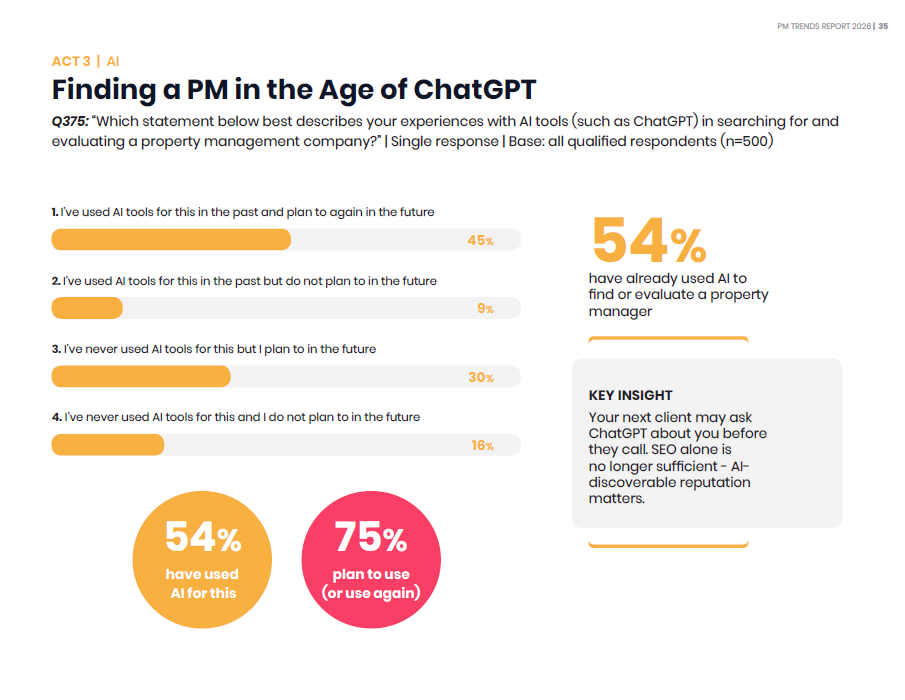
If someone in Belleville, Trenton, or Prince Edward County decides tomorrow that they need a property manager, there's a 54% chance they've already asked an AI tool — ChatGPT, Gemini, Perplexity, or something similar — about their options. And 75% plan to use AI for this kind of search going forward.
That's from the 2026 PM Trends Report, and it represents a fundamental change in how property management companies get discovered and evaluated.
The Old Path vs. The New Path
The traditional discovery path for a property manager was predictable: Google search for "property management [city]," maybe a referral from a realtor or another investor, possibly a recommendation from a local Facebook group. All of those channels still matter. Referrals remain powerful. Google Business Profile still drives local search traffic. Community recommendations still carry weight.
But increasingly, the very first touchpoint is a conversation with an AI tool that synthesizes reviews, website content, service descriptions, social media presence, and online reputation data into a direct recommendation. The prospect doesn't see a list of ten results and pick one. They get a curated answer — often with specific reasoning about why one company fits their needs better than another.
Why This Matters for Owners
Your property manager's digital presence is your property's reputation by extension. When a prospective tenant asks ChatGPT about renting in Belleville, the AI pulls from the same data ecosystem — reviews, website content, social signals. If your PM has a strong, professional digital footprint, your property benefits from that credibility. If your PM is invisible online, your property is invisible too.
The same applies in reverse. When you're searching for a PM, what the AI surfaces depends entirely on what's available to pull from. A property manager with detailed service pages, consistent Google reviews, active social media, clear pricing information, and published content about their market will surface prominently. A PM with a bare-bones website and three reviews from 2019 will be summarized as exactly what they are: an afterthought.
The Generational Context
The AI search adoption numbers are dramatic on their own, but the generational breakdown adds urgency. Among Millennials — who now represent 38% of all landlords and are the fastest-growing segment — AI adoption for PM search is even higher. These aren't future clients in some hypothetical market shift. They are current clients, actively searching right now, and their search behaviour has already changed.
45% of all survey respondents said they've used AI to search for a PM and plan to do so again. Another 30% said they haven't used it yet but plan to. Only 16% said they have no intention of using AI for this purpose. That 16% skews heavily toward Boomers and Exiters — segments that are shrinking as a share of the market.
What Makes a PM AI-Discoverable
AI tools build their recommendations from publicly available data. That means the factors that determine whether a PM surfaces in an AI search are knowable and actionable.
Reviews matter — not just the star rating, but the volume, recency, and specificity. AI reads the text of reviews and synthesizes themes. A review that says "they handled a difficult tenant situation professionally and kept me informed throughout" is more valuable to an AI recommendation engine than a five-star rating with no comment.
Website content matters — clear service descriptions, FAQ pages, market-specific content. AI needs text to pull from. If your PM's website is a single page with a phone number and a stock photo, there's nothing for the AI to work with.
Social presence matters — active social media signals relevance and recency. A PM who posts regularly about their market is read by AI as current and engaged. A dormant social profile is ignored.
Structured data matters — schema markup, Google Business Profile completeness, directory listings. These are the technical foundations that help AI tools categorize and recommend businesses accurately.
What This Means for Media Channels
The PM Trends Report also surveyed where landlords go online to learn about real estate and property management. YouTube dominates at 53%, followed by Facebook at 40%, Instagram at 33%, and TikTok at 32%. Podcasts came in at 16%.
This is the content ecosystem that feeds AI recommendations. A property manager who creates educational YouTube content about their market, maintains an active Facebook presence, posts consistently on Instagram, and publishes written content on their website is creating the raw material that AI tools draw from when generating recommendations.
The two channels — AI search and content creation — are symbiotic. You can't be AI-discoverable without creating the content that AI discovers. And content that serves AI also serves human searchers through traditional channels.
What Blue Anchor Is Doing About This
We've invested deliberately in being findable — not just by Google's traditional algorithm, but by the AI tools that are increasingly driving the first conversation. Our reviews, our content, our service pages, our social presence — all of it is structured so that when someone asks an AI tool about property management in the Quinte region, we show up with substance behind the name.
This blog series itself is part of that strategy. Every post we publish gives AI tools more context about who we are, what we do, how we think about the industry, and what we bring to our market. That's not gaming an algorithm. It's doing the work of demonstrating expertise and letting the tools surface it.
The Question for Every Owner
If your current property manager isn't thinking about AI discoverability, it's worth asking why. Not because AI search is the only channel that matters — but because it reveals something broader about how seriously a PM takes their own business development. A company that's investing in content, reviews, digital presence, and market visibility is almost certainly investing in the operational fundamentals too.
The inverse tends to be true as well.
Source: PM Trends Report 2026, Q375, Q410 (n=500)