How much can your property manager spend on a repair before they need to call you for approval?
It sounds like a simple operational question. But the PM Trends Report reveals that the answer says far more about the owner-PM relationship than most people realize — and it has measurable consequences for repair speed, tenant satisfaction, and long-term retention.
Where the Market Lands
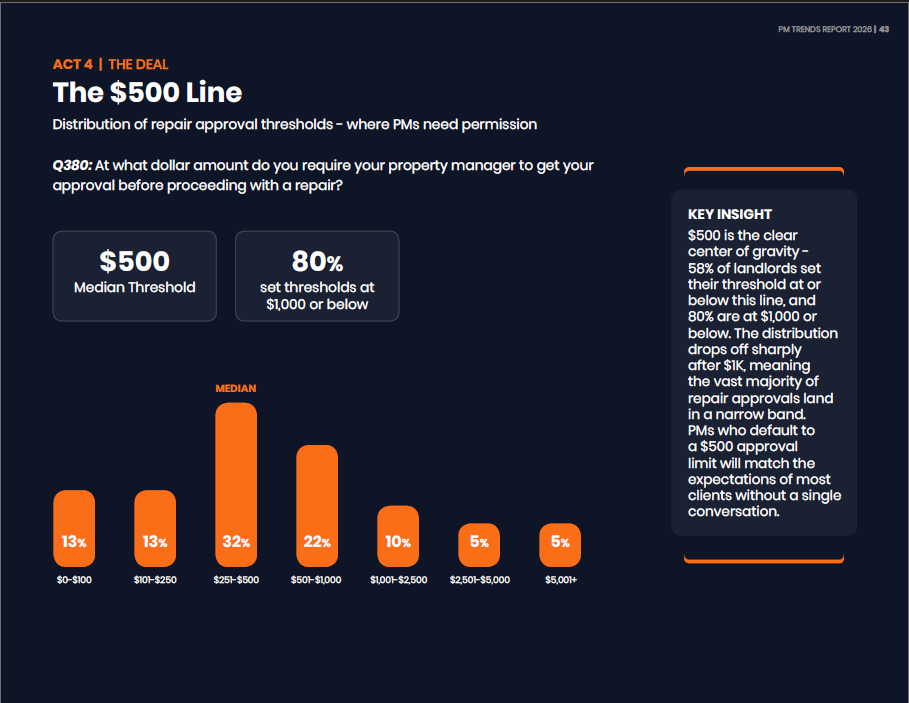
The survey found that the median repair approval threshold is $500. 58% of landlords set their limit at or below that line. 80% are at $1,000 or below. The distribution drops off sharply after $1K — only 10% set thresholds between $1,001 and $5,000, and just 5% go above $5,000.
The $500 line isn't arbitrary. It reflects a natural boundary in residential maintenance costs. Most routine repairs — a running toilet, a leaking faucet, a malfunctioning thermostat, a garbage disposal replacement — fall below $500. Setting a threshold at this level means your PM can handle the majority of day-to-day maintenance without a phone call, while still requiring your authorization for larger jobs like appliance replacements, plumbing overhauls, or HVAC work.
The Segment Variations Tell the Real Story
The median across all landlords is $500, but the variations between segments reveal something deeper. Millennials sit at $500. Expanders at $560. Holders at $500. Repositioners at $500. Boomers land at $200. Exiters at $250.
Active investors — Expanders, Holders, Repositioners, and Millennials — all cluster at $500-560. Once an owner is committed to their portfolio, threshold differences flatten. The operational implication: these owners have enough confidence in their PM's judgment to delegate routine decisions.
Boomers and Exiters are the outliers. The Boomer $200 threshold and the Exiter $250 threshold represent a fundamentally different posture — one where every repair, no matter how small, requires owner involvement.
The researchers flagged a critical insight: a low threshold often signals the relationship isn't working yet — and the data shows it slows down your repairs.
The Speed Cost of Low Thresholds
There's a concrete, measurable price for low approval thresholds. Property Meld analyzed their dataset of 8.6 million work orders and found that repairs requiring owner approval take 33.6% longer to complete — an average of 1.82 additional days per repair.
That delay has cascading effects. The tenant waits longer for resolution, which decreases their satisfaction and their likelihood of renewing. Minor issues can worsen during the delay — a small leak becomes water damage, a rattling fan belt becomes a seized motor. The PM's team spends time on back-and-forth communication instead of resolution.
And here's the paradox: the Boomer $200 threshold sits below the median cost for four of five common residential repair categories. HVAC, plumbing, electrical, and appliance repairs all routinely exceed $200. That means nearly every maintenance event requires a phone call, slowing resolution and increasing the tenant's frustration — which ultimately damages the asset the owner is trying to protect.
What Drives the Threshold: Trust
The trust equation here is directional and well-supported by the data. Owners who trust their PM's financial reporting delegate more. Owners who delegate more have faster repairs. Faster repairs produce happier tenants. Happier tenants stay longer and cause less damage. Less turnover and damage produce better financial outcomes. Better financial outcomes reinforce trust.
The foundation of that virtuous cycle is transparent, accurate financial reporting. Clean books, clear monthly statements, itemized maintenance invoices, and proactive communication about expenses. When an owner can see exactly where every dollar went, they're far more comfortable authorizing the next $500 without a phone call.
What We Recommend
At Blue Anchor, our onboarding process includes a direct conversation about approval thresholds. We recommend $500 for most owners, because the data confirms it aligns with the vast majority of the market and it keeps repairs moving at a pace that serves tenants well.
For owners who want to go higher — and several of our most engaged clients authorize up to $1,000 — we've built the reporting infrastructure through Rentvine to make that trust well-placed. Every work order, every invoice, every vendor payment is documented and accessible through the owner portal in real time.
For owners who want a lower threshold, we accommodate that too — but we have the conversation about what it costs in repair speed and tenant experience. Because the data is clear: the tighter the leash, the slower the repair, and the less satisfied everyone ends up being.
The $500 line isn't just a number. It's a proxy for how well the owner-PM relationship is working.
Source: PM Trends Report 2026, Q380 (n=500); Property Meld 2025 Annual Benchmarking Report (8.6M work orders)